
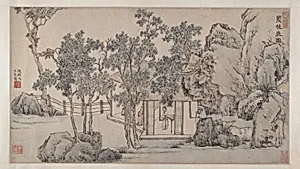
明 文徵明 叢桂齋圖 卷|The Cassia Grove Studio
ca. 1532
Medium
Handscroll; ink and color on paper
Dimensions
Image: 12 7/16 x 22 1/8 in. (31.6 x 56.2 cm) Overall with mounting: 14 x 322 11/16 in. (35.6 x 819.6 cm)
Classification
Paintings
Culture & Period
China · Ming dynasty (1368–1644)
Department
Asian Art
Museum
Metropolitan Museum of Art, New York, NY
Credit
Gift of Douglas Dillon, 1989
Accession Number
1989.303
Rights
Public Domain
Tags
Art Historical Context
Step into the serene world of Ming dynasty literati painting with Wen Zhengming's *The Cassia Grove Studio* (*Chong Gui Zhai Tu*), created around 1532. This exquisite handscroll, rendered in ink and color on paper, measures a compact image area of 12 7/16 x 22 1/8 inches, yet extends dramatically to over 322 inches when fully mounted—a format designed for intimate, sequential viewing by scholars in private settings. The composition captures an idyllic landscape dotted with elegant buildings, evoking the refined retreats of China's cultural elite. Wen Zhengming (1470–1559), a leading figure of the Wu School from Suzhou, championed a personal, expressive style rooted in classical traditions. As a poet, calligrapher, and painter, he blended meticulous brushwork with poetic lyricism, emphasizing harmony between architecture and nature. Cassia groves, symbolized by osmanthus trees, hint at autumnal elegance and scholarly contemplation, reflecting Ming ideals of retreat from worldly strife amid the dynasty's flourishing arts (1368–1644). Handscrolls like this were cultural treasures, often circulated among friends for appreciation, inscriptions, and seals, fostering intellectual bonds. A gift to the Metropolitan Museum of Art from Douglas Dillon in 1989, it exemplifies the enduring allure of Chinese landscape painting, inviting viewers to unroll its timeless tranquility.
About the Artist
Wen Zhengming · 1470–1559
Wen Zhengming (1470–1559), born in Suzhou to a modestly successful scholar-official family, embodied the ideal of the Ming dynasty literati artist. His father, Wen Lin, introduced him early to a leading Suzhou calligrapher, fostering his foundational skills in that art. A late bloomer, Wen studied under the master Shen Zhou, whose guidance shaped his profound reverence for Song and Yuan dynasty ar...