
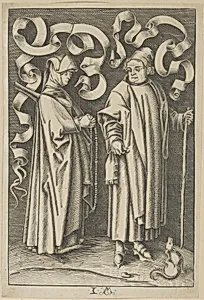
The Churchgoers
Medium
Engraving
Dimensions
Sheet: 6 5/8 × 4 1/2 in. (16.8 × 11.4 cm)
Classification
Prints
Department
Drawings and Prints
Museum
Metropolitan Museum of Art, New York, NY
Credit
Gift of Harry G. Friedman, 1962
Accession Number
62.635.821
Rights
Public Domain
Tags
Art Historical Context
Israhel van Meckenem, a pioneering 15th-century German engraver active around 1465–1503, created *The Churchgoers*, a delicate engraving that captures everyday life with a keen eye for detail. This intimate print, measuring just 6⅝ × 4½ inches, exemplifies the late Gothic style prevalent in Northern Europe, where intricate line work on metal plates allowed for precise reproductions of scenes from daily life and piety. As one of the first artists to extensively sign his works, Meckenem played a crucial role in elevating engraving from craft to fine art, making images accessible beyond elite patrons. The composition likely centers on women making their way to church, adorned with beads—possibly rosaries symbolizing devotion—and accompanied by animals, evoking the blend of spirituality and worldly attachments common in medieval society. These tags hint at a subtle commentary on faith amid human foibles, a theme Meckenem explored in his vast output of over 600 prints. Produced via intaglio technique, where lines are incised into copper and inked under pressure, the medium revolutionized visual culture by enabling multiple impressions for broader distribution. Housed in the Metropolitan Museum of Art's Drawings and Prints department as a 1962 gift from Harry G. Friedman, *The Churchgoers* offers visitors a window into late medieval devotion and social norms, reminding us how art bridged the sacred and secular in an era of religious fervor.
About the Artist
Israhel van Meckenem|Anonymous · 1435–1503
Israhel van Meckenem (c. 1445–1503), also known as Israhel van Meckenem the Younger, was a pioneering German engraver and goldsmith based in Bocholt, near the Dutch border, renowned as the most prolific printmaker of the fifteenth century. Born into a family possibly of Dutch origin, he was the son of Israhel van Meckenem the Elder, a goldsmith who settled in Bocholt in 1457. He trained initially ...