
The Churchgoers
c. 1495/1503
Medium
engraving
Classification
Department
CG-E
Museum
National Gallery of Art, Washington, D.C.
Credit
Rosenwald Collection
Accession Number
1943.3.156
Rights
Public Domain
Art Historical Context
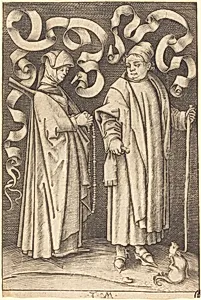
Israhel van Meckenem *The Churchgoers*, created around 1495–1503, captures a lively procession of everyday folk heading to worship in late medieval Germany. As a master engraver of the Northern Renaissance, van Mecken (c. 1445–1503) excelled depicting contemporary life with sharp social observation, blending religious piety and secular fashion in intricate detail. This print showcases his signature style: fine, cross-hatched lines that evoke texture in clothing, faces, and architecture, drawing viewers into a bustling scene of community ritual. Engraving, the medium here, revolutionized art dissemination in the 15th century. Van Meckenem incised designs into copper plates, allowing multiple impressions on paper—a democratic alternative to costly paintings. Housed in the National Gallery of Art's Rosenwald Collection (Department CG-E), this work reflects the era's Gothic-to-Renaissance transition, where prints like this educated and entertained the emerging middle class, commenting subtly on devotion amid worldly vanities. A gem of early printmaking, *The Churchgoers* invites us to ponder the timeless rhythm of faith and fellowship, preserved through van Meckenem's masterful technique.
About the Artist
Israhel van Meckenem · 1435–1503
Israhel van Meckenem (c. 1445–1503), also known as Israhel van Meckenem the Younger, was a pioneering German engraver and goldsmith based in Bocholt, near the Dutch border, renowned as the most prolific printmaker of the fifteenth century. Born into a family possibly of Dutch origin, he was the son of Israhel van Meckenem the Elder, a goldsmith who settled in Bocholt in 1457. He trained initially ...