
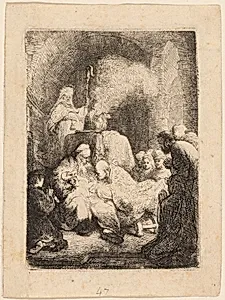
The Circumcision: Small Plate
c. 1630
Medium
Etching with drypoint on ivory laid paper
Dimensions
Image/plate: 9 × 6.3 cm (3 9/16 × 2 1/2 in.); Sheet: 10.7 × 8.1 cm (4 1/4 × 3 1/4 in.)
Classification
etching
Department
Prints and Drawings
Museum
Art Institute of Chicago
Accession Number
29104
Rights
Public Domain
Art Historical Context
In the intimate glow of Rembrandt van Rijn's *The Circumcision: Small Plate (c. 1630), we witness a tender biblical moment: the circumcision of the Christ child, as described in the Gospel of Luke. Created when Rembrandt was in his mid-twenties, during his early years in Leiden and Amsterdam amid the Dutch Golden Age, this etching captures the artist's emerging genius for drama and emotion in miniature scale—just 9 × 6.3 cm. Religious subjects like this were staples of 17th-century Northern European art, reflecting the era's Protestant devotion and Rembrandt's lifelong fascination with sacred narratives. Rembrandt's mastery shines through his innovative etching and drypoint techniques on ivory laid paper. Etching allowed precise, fluid lines etched by acid, while drypoint—scratched directly into the plate—produced velvety burrs that yield rich, tonal depths and subtle shadows, mimicking the chiaroscuro effects of his paintings. This "small plate" exemplifies his experimental printmaking phase, where he pushed the medium's limits to evoke light piercing darkness, drawing viewers into the scene's quiet intensity. Housed in the Art Institute of Chicago's Prints and Drawings collection, this rare work highlights Rembrandt's pivotal role in elevating printmaking from reproductive tool to expressive art form. Its diminutive size belies its monumental impact, inviting close contemplation of humanity's spiritual core.
About the Artist
Rembrandt van Rijn · 1606–1669
Rembrandt Harmenszoon van Rijn (1606–1669) stands as one of the greatest visual artists in the history of Western art and the most important Dutch painter of the 17th century. Born in Leiden to a prosperous miller's family, Rembrandt transformed painting through his revolutionary use of light and shadow, his psychological depth in portraiture, and his elevation of etching to a fine art. His approx...