
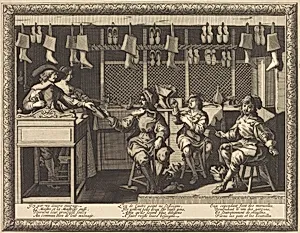
The Cobbler
1601 to 1650
Medium
etching on laid paper
Dimensions
image: 25.8 × 33.6 cm (10 3/16 × 13 1/4 in.) plate: 27 × 34.6 cm (10 5/8 × 13 5/8 in.) sheet: 27.4 × 35 cm (10 13/16 × 13 3/4 in.)
Classification
Department
CG-E
Museum
National Gallery of Art, Washington, D.C.
Credit
Rosenwald Collection
Accession Number
1951.16.12
Rights
Public Domain
Art Historical Context
Abraham Bosse's *The Cobbler*, an etching on laid paper from the early to mid-17th century (ca. 1601–1650), captures the humble craft of shoemaking in exquisite detail. Bosse, a leading French printmaker of his time (1602–1676), was renowned for his precise etchings that brought everyday Parisian life to life, bridging the gap between elite art and the working class. This print, measuring about 10 by 13 inches, exemplifies his mastery of the etching technique, where acid etches intricate lines into a copper plate, allowing for fine textures like leather tools and worn faces. Etchings like this were revolutionary in the Baroque era, making high-quality art accessible through multiple impressions on laid paper—a period handmade sheet with subtle chain lines adding to its tactile authenticity. *The Cobbler* reflects the growing cultural fascination with genre scenes, portraying ordinary laborers not as caricatures but with dignity and realism, influencing later Dutch and French artists. Housed in the National Gallery of Art's Rosenwald Collection, this work invites visitors to appreciate the artistry in the mundane. Imagine the cobbler's focused gaze amid scattered lasts and scraps—Bosse's lens on 17th-century urban vitality endures, reminding us of the hands behind our daily comforts.
About the Artist
Abraham Bosse · 1602–1676
Abraham Bosse (1604–1676) was a French printmaker and theorist whose approximately 1,600 etchings provide an unparalleled visual record of 17th-century French life. Born to Huguenot parents in Tours, he trained in Paris under Melchior Tavernier and became a devoted follower of Jacques Callot's technical innovations. Bosse's meticulous etchings depicted subjects ranging from daily life and fashion ...