
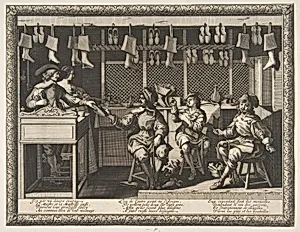
The Cobbler (Le Savetier)
ca. 1632–33
Medium
Etching
Dimensions
sheet: 10 1/8 x 13 1/4 in. (25.7 x 33.6 cm)
Classification
Prints
Department
Drawings and Prints
Museum
Metropolitan Museum of Art, New York, NY
Credit
The Elisha Whittelsey Collection, The Elisha Whittelsey Fund, 1951
Accession Number
51.501.2250
Rights
Public Domain
Tags
Art Historical Context
The Cobbler (Le Savetier), an etching created around 1632–33 by Abraham Bosse with publisher Melchior Tavernier, captures a lively moment inside a 17th-century French workshop. At roughly 10 by 13 inches, the print shows a shoemaker surrounded by men and women, with shoes prominently featured amid the tools and furnishings of an everyday interior. Bosse specialized in such genre scenes that recorded the routines of ordinary citizens during the reign of Louis XIII. Etching proved ideal for this subject because its fine lines could render textures like leather and fabric with clarity while allowing the image to be printed in quantity. Affordable and widely circulated, works like this one helped bring images of contemporary trades and social interactions to a broad public beyond court circles. Today the print offers modern viewers a window into the period’s material culture, where skilled craftspeople played a vital role in community life. Its careful observation of domestic space and human activity remains both informative and engaging.
About the Artist
Abraham Bosse|Melchior Tavernier · 1602–1676
Abraham Bosse (1604–1676) was a French printmaker and theorist whose approximately 1,600 etchings provide an unparalleled visual record of 17th-century French life. Born to Huguenot parents in Tours, he trained in Paris under Melchior Tavernier and became a devoted follower of Jacques Callot's technical innovations. Bosse's meticulous etchings depicted subjects ranging from daily life and fashion ...