
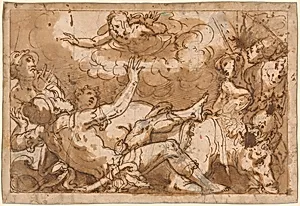
The Conversion of Saint Paul
1554
Medium
Pen and brown ink, brush and brown wash, with splatters of gray, green and pink paint over black chalk, squared in black chalk, on cream laid paper, with framing lines in pen and brown ink, laid down on secondary paper
Dimensions
18.2 × 26.7 cm (7 3/16 × 10 9/16 in.)
Classification
drawings (visual works)
Department
Prints and Drawings
Museum
Art Institute of Chicago
Accession Number
244912
Rights
Public Domain
About this artwork
This lively sketch is a preparatory drawing for one of three 1555 frescoes that Vasari painted for a church ceiling vault in the central Italian town of Cortona. The artist’s line, rapidly applied in pen and ink, belies the careful thought given to the composition, in which Vasari makes utmost use of the scene’s horizontal format. The paint stains on the drawing’s right side indicate that this was a working drawing used in the painting process.
Art Historical Context
Giorgio Vasari’s *The Conversion of Saint Paul* (1554) captures a pivotal biblical moment when Saul, struck by divine light on the road to Damascus, transforms into the apostle Paul. Created during the height of the Counter-Reformation, the drawing reflects the era’s emphasis on dramatic religious narratives designed to inspire faith and devotion. Vasari, the celebrated Tuscan painter, architect, and author of *Lives of the Artists*, often explored such dynamic subjects in both his paintings and preparatory works. This sheet reveals Vasari’s working process through its layered techniques: fluid pen lines, rich brown washes for modeling forms, and delicate splatters of colored paint that add vibrancy. Most tellingly, the composition is squared in black chalk—a grid system that allowed the artist to enlarge and transfer the design to a larger canvas or fresco. Such drawings offer modern viewers an intimate glimpse into the creative methods of Renaissance masters. Housed in the Art Institute of Chicago’s Prints and Drawings department, the work exemplifies Vasari’s central role in shaping Mannerist style while documenting the careful planning behind grand religious commissions of the sixteenth century.
About the Artist
Giorgio Vasari · 1511–1574
Vasari was a productive court artist and architect in Florence during the first half of the 16th century, with his primary patrons being Alessandro and Ippolito de' Medici, until 1537 with the death of Alessandro. However, he is most well known for his book "Le vite de' più eccellenti architetti, pittori, et scultori Italiani," which was first published in 1550, and once again in 1568 in an expand...