
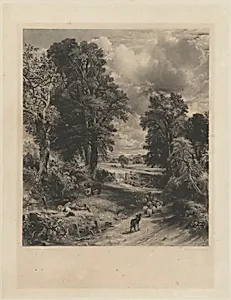
The Cornfield
in or after 1832
Medium
mezzotint [progress proof]
Classification
Department
CG-E
Museum
National Gallery of Art, Washington, D.C.
Credit
Paul Mellon Collection
Accession Number
1975.46.26
Rights
Public Domain
Art Historical Context
Step into the sun-dappled fields of rural England with *The Cornfield*, a mezzotint progress proof by David Lucas after John Constable in or after 1832., a master of Romantic landscape painting, drew inspiration from his Suffolk boyhood for his original 1826 oil painting of the same title, evoking nostalgia for a vanishing agrarian life amid the Industrial Revolution's shadow. Lucas, Constable's favored engraver, faithfully captured this idyllic scene—likely featuring a winding path through golden wheat, distant trees, and a horse-drawn wagon—in this print from the acclaimed *English Landscape Scenery* series. Mezzotint, a 17th-century intaglio technique, revolutionized printmaking by allowing velvety blacks and subtle gradations that mimic oil paint's luminosity. As a "progress proof," this early-stage impression reveals the meticulous scraping and polishing process, offering rare insight into the collaboration between artist and engraver. Printed on laid paper, it showcases evolving tones from dark grounds to luminous highlights, bridging painting and print for wider audiences. Housed in the National Gallery of Art's Paul Mellon Collection (Department CG-E), *The Cornfield* highlights 19th-century Britain's reverence for nature's beauty and the innovative role of reproductive prints in democratizing art. A testament to Constable's enduring influence, it invites visitors to ponder the timeless harmony of light, labor, and landscape.