
The Crucifixion
Medium
Tempera on wood, gold ground
Dimensions
33 7/8 × 20 5/8 in. (86 × 52.4 cm)
Classification
Paintings
Department
European Paintings
Museum
Metropolitan Museum of Art, New York, NY
Credit
Purchase, Gwynne Andrews Fund; Charles and Jessie Price and Álvaro Saieh Bendeck Gifts; Philippe de Montebello Fund; Gift of Mrs. William M. Haupt, from the collection of Mrs. James B. Haggin, Bequest of Lillian S. Timken, and Gift of Forsyth Wickes, by exchange; Marquand and Victor Wilbour Memorial Funds; funds from various donors and Gifts of the Marquis de La Bégassière and Cornelius Vanderbilt, by exchange; and The Alfred N. Punnett Endowment Fund, 2018
Accession Number
2018.87
Rights
Public Domain
Tags
Art Historical Context
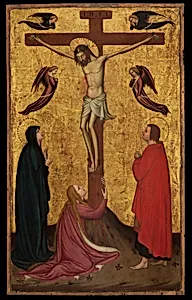
Stefano da Verona's *The Crucifixion*, dating to around 1400, captures a pivotal moment in Christian iconography: Christ on the cross, mourned by the Virgin Mary Mary Magdalene, with angels gathering his blood in chalices—a poignant symbol of the Eucharist. Painted in tempera on wood with a shimmering gold ground, this panel early Italian religious art. The gold leaf, meticulously punched and tooled, evokes heavenly radiance, drawing the viewer's eye to the divine drama unfolding against an ethereal backdrop. Working in Verona at the cusp of the Gothic and Renaissance eras, Stefano da Verona (also known as Stefano di Giovanni d'Arbosio di Francia) blended northern Italian traditions with possible French influences hinted at in his name. Tempera, an egg-based medium applied in thin glazes, allowed for exquisite detail in the figures' expressive faces and flowing drapery, heightening emotional intensity. Such panels often served as devotional aids or altarpiece components, inviting contemplation of Christ's sacrifice. Acquired by The Metropolitan Museum of Art in 2018 through generous gifts and funds, this work highlights the Veronese school's role in bridging medieval piety with emerging humanism, offering visitors a luminous window into 15th-century spirituality.