
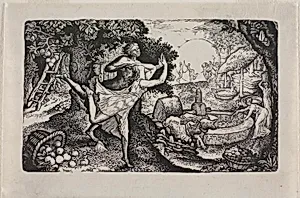
The Cyder Feast
n.d.
Medium
Woodcut on paper
Dimensions
Image: 7.6 × 12.7 cm (3 × 5 in.); Sheet, trimmed within platemark: 9.8 × 14.8 cm (3 7/8 × 5 7/8 in.)
Classification
reproduction
Department
Prints and Drawings
Museum
Art Institute of Chicago
Accession Number
4698
Rights
Public Domain
Art Historical Context
"The Cyder Feast" by Edward Calvert is a charming example of early nineteenth-century printmaking preserved in the Art Institute of Chicago’s Prints and Drawings collection. Though undated, the small woodcut—measuring only three by five inches—captures the intimate scale typical of Calvert’s work. Its classification as a reproduction suggests it was created to share the artist’s vision with a wider audience through the reproducible nature of the medium. Woodcut technique, one of the oldest methods of printmaking, involves carving an image into a wooden block so that the raised surfaces hold ink and transfer it to paper. This process allowed artists like Calvert to produce multiple impressions, making art more accessible while preserving the handcrafted quality of each print. The trimmed sheet further emphasizes the work’s focus on the image itself, inviting viewers to appreciate the fine lines and textures achieved through careful carving. The title hints at a festive rural scene, aligning with the pastoral subjects often explored in prints of this era. Such works encourage quiet reflection on themes of community, nature, and tradition, offering museum visitors a glimpse into the enduring appeal of woodcut as both an artistic and democratic medium.