
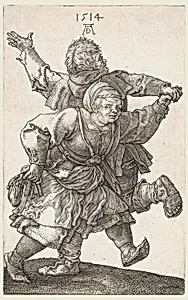
The Dancing Peasants
Classification
figures
Department
Smithsonian Collection
Museum
Smithsonian American Art Museum
Credit
Smithsonian American Art Museum
Accession Number
1950-87-6
Rights
Public Domain
About this artwork
Research in Progress
Art Historical Context
Albrecht Dürer created "The Dancing Peasants" in 1514 during the height of the Northern Renaissance. A German artist celebrated for his innovations in printmaking and drawing, Dürer often explored both sacred and secular themes with extraordinary precision. This work, classified among his figure studies, reflects his keen interest in capturing the human body in motion and the rhythms of everyday life. The scene of peasants dancing offers a window into early sixteenth-century European culture, where communal celebrations and folk traditions played a vital role in rural society. Dürer’s approach to such subjects helped elevate ordinary people as worthy artistic topics, blending observation with a sense of vitality and humor. Housed in the Smithsonian American Art Museum, the piece invites viewers to appreciate Dürer’s enduring influence on how artists portray movement and social customs. Though research on its specific medium continues, the work remains a testament to his skill in rendering expressive figures that still resonate today.