
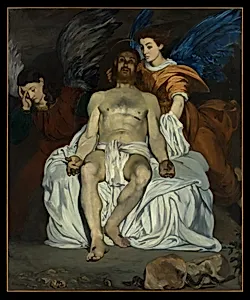
The Dead Christ with Angels
1864
Medium
Oil on canvas
Dimensions
70 5/8 x 59 in. (179.4 x 149.9 cm)
Classification
Paintings
Department
European Paintings
Museum
Metropolitan Museum of Art, New York, NY
Credit
H. O. Havemeyer Collection, Bequest of Mrs. H. O. Havemeyer, 1929
Accession Number
29.100.51
Rights
Public Domain
Tags
Art Historical Context
Edouard Manet's *The Dead Christ with Angels* (1864), a monumental oil on canvas measuring nearly six by five feet, captures a poignant religious scene in the Metropolitan Museum of Art's European Paintings collection. Painted during a pivotal moment in Manet's career—amid controversy over his modern takes on classical subjects like *Olympia*—this work draws inspiration from Old Masters such as El Greco and Titian. Yet Manet's signature Realism shines through in his stark, unidealized depiction of Christ's pale, lifeless body, flanked by sorrowful angels, emphasizing raw human vulnerability over divine transcendence. The composition's dramatic lighting and bold brushwork foreshadow Impressionism, while symbolic elements like coiled snakes evoke temptation and mortality, linking Christ's sacrifice to biblical themes of sin and redemption. These serpentine motifs, unusual in traditional iconography, add a layer of psychological tension, inviting viewers to ponder the interplay of innocence (angels) and evil. Acquired through the H.O. Havemeyer Collection in 1929, this painting exemplifies Manet's challenge to 19th-century academic norms, blending reverence with innovation. It's a masterful reminder of how one artist's vision can reanimate sacred stories for a secular age.
About the Artist
Edouard Manet · 1832–1883
Édouard Manet (1832-1883) was a French painter who played a pivotal role in the transition from Realism to Impressionism, often called the 'Father of Modern Art.' Born into a wealthy Parisian family, Manet defied his father's wishes for a legal career to pursue painting, studying under academic artist Thomas Couture. His revolutionary works 'Le Déjeuner sur l'herbe' and 'Olympia' (both 1863) scand...