
The Death of Harlequin
1905/1906
Medium
pen and black ink with watercolor on laid paper
Dimensions
overall: 10.4 x 16.8 cm (4 1/8 x 6 5/8 in.)
Classification
Drawing
Department
CG-W
Museum
National Gallery of Art, Washington, D.C.
Credit
Collection of Mr. and Mrs. Paul Mellon
Accession Number
1996.129.2
Rights
Public Domain
Art Historical Context
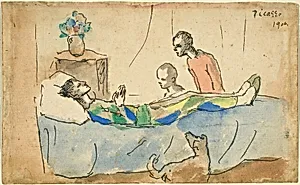
In the heart of Pablo Picasso's Rose Period (roughly 1904–1906), *The Death of Harlequin captures a poignant moment from 1905/1906. This intimate drawing on laid paper, measuring just 10.4 x 16.8 cm, depicts the iconic commedia dell'arte figure Harlequin—a recurring muse for the young Picasso, symbolizing vulnerability amid the artist's shift from the somber blues of his earlier work to warmer, more lyrical pinks and earth tones. Created during Picasso's time in Paris, it reflects his fascination with circus performers and performers' tragic undercurrents, blending melancholy with theatrical grace. Executed in pen and black ink heightened with watercolor, the piece showcases Picasso's masterful line work: fluid, expressive strokes that convey Harlequin's limp form and diamond-patterned costume with economical precision. The watercolor adds subtle washes of color, evoking a sense of fading life and emotional depth. As a drawing rather than a grand canvas, it reveals the artist's exploratory process, bridging his formative years toward Cubism. Today, this gem from the Collection of Mr. and Mrs. Paul Mellon graces the National Gallery of Art. It invites visitors to ponder Picasso's early empathy for the marginalized, offering a window into the genius who would redefine modern art.
About the Artist
Pablo Picasso · 1881–1973
Pablo Picasso (1881–1973), born Pablo Diego José Francisco de Paula Juan Nepomuceno María de los Remedios Cipriano de la Santísima Trinidad Ruiz y Picasso in Málaga, Spain, was the son of José Ruiz Blasco, a painter and art professor who served as his first teacher. From age seven, Picasso trained under his father in figure drawing and oil painting, mastering naturalistic techniques by copying mas...