
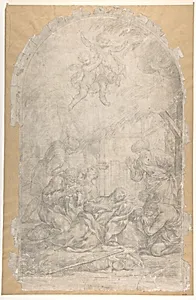
The Death of Saint Francis Xavier
1674–79
Medium
Black chalk
Dimensions
20-1/16 x 12-5/8 in. (51.0 x 32.0 cm)
Classification
Drawings
Department
Drawings and Prints
Museum
Metropolitan Museum of Art, New York, NY
Credit
Purchase, Mrs. Carl Selden and Florence and Carl Selden Foundation Gifts, 1966
Accession Number
66.9
Rights
Public Domain
Tags
Art Historical Context
In the hushed drama of *The Death of Saint Francis Xavier (1674–79), Italian Baroque artist Ciro Fer captures a pivotal moment in the life of the renowned Jesuit missionary. Rendered black chalk on a modest sheet measuring 20-1/16 x 12-5/8 inches, this drawing from the Metropolitan Museum of's Drawings and Prints department the saint's final moments, likely evoking the solemnity of his death in 1552 on a remote Chinese island while spreading Christianity across Asia. Ferri, a pupil of the grand mannerist Pietro da Cortona, was renowned for his fluid draughtsmanship, and this work exemplifies his ability to convey pathos through subtle tonal gradations. Black chalk, a favored medium in the 17th century, allowed Ferri to achieve rich contrasts and expressive modeling, ideal for preparatory studies or standalone devotional pieces during the Counter-Reformation era. Saint Francis Xavier, canonized in 1622, became a symbol of missionary zeal for the Jesuits, making scenes of his death popular in Baroque art to inspire faith and emotional devotion. Acquired in 1966 through generous gifts, this drawing offers visitors a window into Ferri's mastery of religious narrative, blending historical reverence with artistic intimacy in the Met's esteemed collection.
About the Artist
Ciro Ferri · 1634–1689
Ciro Ferri (1634–1689) was an Italian Baroque painter and engraver who served as the principal artistic heir and studio assistant of Pietro da Cortona, the dominant decorative painter of seventeenth-century Rome. Born in Rome, Ferri entered Cortona's workshop as a young man and proved so skilled that he became the master's most trusted collaborator, eventually taking over the completion of major c...