
The Dissolute Household
1501 to 1550
Medium
engraving on laid paper
Dimensions
plate: 20.5 × 28.9 cm (8 1/16 × 11 3/8 in.) sheet: 21.5 × 29.5 cm (8 7/16 × 11 5/8 in.)
Classification
Department
CG-E
Museum
National Gallery of Art, Washington, D.C.
Credit
Rosenwald Collection
Accession Number
1943.3.1449
Rights
Public Domain
Art Historical Context
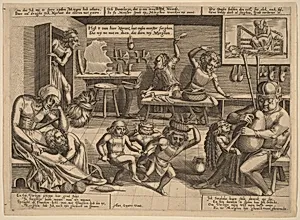
Pieter Balten’s “The Dissolute Household” is a finely detailed engraving created in the first half of the sixteenth century, when Flemish artists were exploring lively scenes of everyday life infused with moral messages. Balten, active in Antwerp, often portrayed domestic settings to comment on social behavior, and this print likely shows a home overtaken by disorder and excess—tables overturned, figures carousing—to warn viewers about the consequences of neglecting order and virtue. Executed on laid paper, the engraving demonstrates the period’s growing interest in printmaking as a means of reaching wider audiences. The technique allowed intricate line work to be reproduced and shared beyond the original plate, turning private moral lessons into public commentary. Measuring just over eight by eleven inches, the intimate scale encourages close looking, inviting museum visitors to discover the small, telling details that reveal the household’s unraveling. Today the work resides in the National Gallery of Art’s Rosenwald Collection, preserving a vivid example of how Northern Renaissance prints blended entertainment with gentle instruction.