
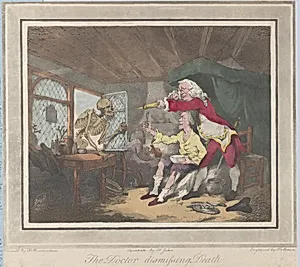
The Doctor Dismissing Death
Medium
Hand-colored etching and aquatint
Dimensions
Sheet (trimmed): 11 11/16 × 12 13/16 in. (29.7 × 32.5 cm)
Classification
Prints
Department
Drawings and Prints
Museum
Metropolitan Museum of Art, New York, NY
Credit
The Elisha Whittelsey Collection, The Elisha Whittelsey Fund, 1959
Accession Number
59.533.2034
Rights
Public Domain
Tags
Art Historical Context
**The Doctor Dismissing Death**1785) is a vibrant satirical print created by a talented collaboration of British artists: Francis Jukes, John Raphael, Peter Simon, and renowned caricaturist Thomas Rowlandson Produced as a hand-colored etching and aquat, this medium was revolutionary in the late 18th century, precise etched lines with aquatint's tonal washes for rich, painterly effects, then enhanced by meticulous hand-coloring to heighten its dramatic appeal. Measuring about 12 inches square, it exemplifies the booming print market that made art accessible beyond elite patrons. The scene humorously depicts a confident doctor waving away a skeletal figure of Death, surrounded by anxious men, poking fun at medical hubris and quackery during the Enlightenment era. Rowlandson's sharp wit shines through, critiquing the era's often theatrical physicians who promised cures amid high mortality from diseases like consumption. Skeletons as symbols of mortality were a staple in Georgian satire, underscoring human folly. Housed in the Metropolitan Museum of Art's Drawings and Prints department, this work captures the cultural zeitgeist of 1780s London, where satire thrived in taverns and print shops. Its lively colors and exaggerated forms invite viewers to chuckle at timeless themes of life, death, and overconfident expertise.
About the Artist
Francis Jukes|John Raphael Smith|Peter Simon|Thomas Rowlandson · 1745–1812
Francis Jukes was born in 1745 in Martley, Worcestershire, and became one of England’s most prolific engravers and publishers of the late eighteenth and early nineteenth centuries. He began his career as a topographical painter before turning to etching and line engraving. He then mastered aquatint, a tonal printmaking process he learnt from the watercolourist Paul Sandby, becoming one of the earl...