
The Draped Figure, Back View
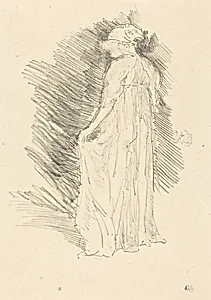
Medium
lithograph in black on laid paper
Dimensions
image: 20.6 × 15 cm (8 1/8 × 5 7/8 in.) sheet: 33.1 × 21.3 cm (13 1/16 × 8 3/8 in.)
Classification
Department
CG-W
Museum
National Gallery of Art, Washington, D.C.
Credit
Rosenwald Collection
Accession Number
1943.3.8727
Rights
Public Domain
Art Historical Context
James McNeill Whistler’s *The Draped Figure, View* (1893) is a striking lithograph in black on laid paper, capturing the contours of a draped figure seen from behind. Measuring just 20.6 × 15 cm for the image, this intimate print exemplifies Whistler’s late-career mastery of lithography, a medium he championed to achieve painterly effects akin to renowned oil paintings. Printed on textured laid paper, it highlights the artist’s precise control over tone and line, creating a sense of ethereal harmony through soft shadows and fluid drapery folds. Whistler, an American expatriate in London and a leader of the Aesthetic movement, prioritized “art for art’s sake,” emphasizing mood and composition over narrative. By the 1890s, after his famous libel trial against critic John Ruskin, he turned extensively to lithography, producing over 120 prints that explored everyday motifs with impressionistic subtlety. This work, from the National Gallery of Art’s Rosenwald Collection (Department CG-W), reflects his fascination with the human form as abstract beauty, reducing the figure to essential silhouettes and tonal values. Its cultural significance lies in Whistler’s innovative transfer lithography technique, which allowed velvety blacks and delicate grays, bridging fine art and printmaking. A testament to his influence on modern abstraction, it invites viewers to appreciate the poetry in simplicity.
About the Artist
James McNeill Whistler · 1834–1903
James Abbott McNeill Whistler (1834-1903) was an American-born painter and printmaker who became a leading figure in the Aesthetic Movement and pioneer of Tonalism and Japonisme. He revolutionized art by championing "art for art's sake" and treating paintings as visual equivalents of musical compositions, titling works as "arrangements," "harmonies," and "nocturnes" to emphasize formal qualities o...