
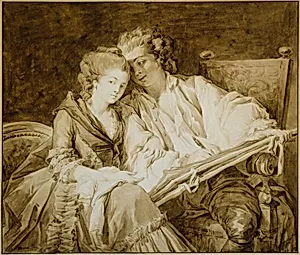
The Drawing Lesson
Medium
brush and brown wash over graphite on cream laid paper, laid down, with a framing line in brown ink
Dimensions
sheet: 32.5 x 37.7 cm (12 13/16 x 14 13/16 in.) overall (framed): 57.2 x 61.6 cm (22 1/2 x 24 1/4 in.)
Classification
Drawing
Department
CG-E
Museum
National Gallery of Art, Washington, D.C.
Credit
Anonymous Partial and Promised Gift
Accession Number
2000.99.1
Rights
Public Domain
Art Historical Context
**The Drawing Lesson** (1777) by Françoisré Vincent invites visitors into an intimate glimpse of artistic education in late 18th-century France Created with brush and brown wash over on cream laid paper, delicate drawing measures 32.5 x 37.7 cm and captures a tender moment likely between a teacher and young pupil, emphasizing the foundational role of drawing in classical training. Vincent, a prominent French history painter and pupil of Joseph-Marie Vien crafted this work during a pivotal era when the Académie Royale promoted rigorous draftsmanship amid the shift from Rococo ornamentation to Neoclassical restraint. The medium exemplifies economical yet expressive techniques of the time: graphite sketches loose forms, while brown wash adds subtle tonal modeling and depth, enhanced by a framing line in brown ink. Laid down for preservation, it hints at its preparatory function, possibly for a larger painting, showcasing Vincent's skill in conveying narrative and emotion through monochrome. Housed in the National Gallery of Art as an anonymous partial and promised gift (Department CG-E), this piece underscores drawing's status as the cornerstone of artistic mastery. In the Enlightenment spirit of 1777, just before the French Revolution, such scenes celebrated intellectual pursuit and pedagogy, reflecting cultural reverence for the arts as paths to refinement. A charming study in patience and progress, it reminds us how every great masterpiece begins with a single line.
About the Artist
François-André Vincent · 1746–1816
French painter and draughtsman. He was one of the principal innovators in French art of the 1770s and 1780s, in the field of both Neo-classical subjects and themes from national history. Comment on works: Portraits; History