
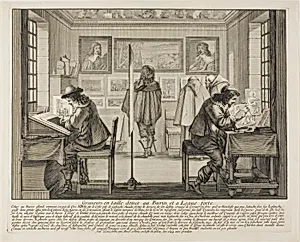
The Engraver and the Etcher
1643
Medium
Etching on ivory laid paper
Dimensions
Plate: 25.7 × 32.4 cm (10 1/8 × 12 13/16 in.); Sheet: 27.5 × 34 cm (10 7/8 × 13 7/16 in.)
Classification
etching
Department
Prints and Drawings
Museum
Art Institute of Chicago
Accession Number
72665
Rights
Public Domain
About this artwork
Abraham Bosse wrote the first important treatise on the art of etching in 1645. His highly influential publication urged etchers to aspire to the precision of engravers, rather than cultivating the peculiarities of the etched line, like Rembrandt. To achieve a swelling line akin to an engraving, bosse utilized an instrument called an 'échoppe', a beveled etching needle, which he could twist in the ground to create variable widths of etched line, similar to the work of Jacques Callot. In this pri...
Art Historical Context
Abraham Bosse's *The Engraver and thecher* (1643) is a captivating etching that offers a window into the world of 17th-century print. Created on ivory laid paper—a fine, textured support prized for its ability to hold intricate lines—this work measures about 10 by 13 inches and exemplifies Bosse's mastery of the etching technique. As a leading French artist of the Baroque era, B was renowned for his realistic depictions of daily life and his pioneering role in documenting artistic processes, making this piece both a technical demonstration and a historical snapshot. The title reveals the artwork's focus: contrasting the meticulous labor of the engraver, who incises lines directly into a copper plate with a burin, and the etcher, who draws through a wax ground for acid to "bite" the grooves. Bosse, who authored influential treatises like *The Manner of Achieving Etchings* (1645), used such images to educate fellow artists on these methods, elevating printmaking from craft to fine art. Produced amid France's artistic golden age under Louis XIII, it highlights the growing prestige of prints as accessible multiples. Housed in the Art Institute of Chicago's Prints and Drawings Department, this etching invites visitors to appreciate the precision and innovation that defined Bosse's legacy, bridging technical skill with cultural insight into an era when visual knowledge was shared through the press.
About the Artist
Abraham Bosse · 1602–1676
Abraham Bosse (1604–1676) was a French printmaker and theorist whose approximately 1,600 etchings provide an unparalleled visual record of 17th-century French life. Born to Huguenot parents in Tours, he trained in Paris under Melchior Tavernier and became a devoted follower of Jacques Callot's technical innovations. Bosse's meticulous etchings depicted subjects ranging from daily life and fashion ...