
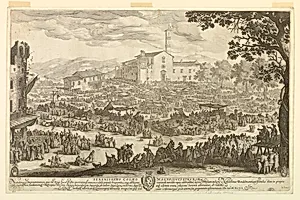
The Fair at Impruneta
Classification
Department
Smithsonian Collection
Museum
Smithsonian American Art Museum
Credit
Bequest of Erskine Hewitt
Accession Number
1938-57-1613
Rights
Public Domain
About this artwork
Research in Progress
Art Historical Context
Jacques Callot's *The Fair at Impruneta* (1620) captures the vibrant chaos of a bustling 17th-century Italian fair, a scene from the annual festival in Impruneta, near Florence. As a masterful French printmaker (1592–1635), Callot was renowned for intricate etchings that brought everyday life and spectacle to life with remarkable detail. Working extensively in Italy during this period, he drew inspiration from the region's lively traditions, transforming this print into a vivid snapshot of Baroque-era social gatherings filled with vendors, performers, and revelers. This work exemplifies Callot's pioneering etching techniques, which allowed for unprecedented precision in rendering crowds and architecture within a single composition. His fine lines and meticulous cross-hatching created depth and movement, influencing generations of printmakers. As part of the Smithsonian American Art Museum's collection—bequeathed by Erskine Hewitt—this print highlights the artist's ability to document cultural festivities with both humor and humanity, offering visitors a window into Renaissance Italy's communal joys amid a time of political flux. Though research continues, *The Fair at Impruneta* stands as a testament to Callot's genius in elevating the ordinary into art, inviting us to linger on the timeless energy of human connection.