
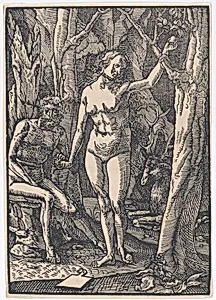
The Fall of Man
ca. 1508–1532
Medium
Woodcut; third state of three
Dimensions
Sheet: 7 in. × 4 15/16 in. (17.8 × 12.6 cm)
Classification
Prints
Department
Drawings and Prints
Museum
Metropolitan Museum of Art, New York, NY
Credit
Harris Brisbane Dick Fund, 1947
Accession Number
47.100.185
Rights
Public Domain
Art Historical Context
Behold *The Fall of Man*, a woodcut by Ludwig Krug, a Nuremberg goldsmith and printmaker active in the early 16th. Created around 1508–1532, this third state of three captures the biblical moment of Adam and Eve's from Eden, a theme central to Christian iconography during the Northern Renaissance. Measuring just 7 × 4 15/16 inches, its compact size made it ideal for devotional books, broadsheets, or personal collections, democratizing art for a wider audience beyond the elite. Krug's work reflects the meticulous draftsmanship of German printmakers like Albrecht Dürer, his contemporary. Woodcuts, carved in relief from wooden blocks, allowed for bold lines and high contrast, perfect for black-and-white reproduction. The "third state" indicates refinements over earlier versions—perhaps added details or corrections—showcasing the iterative craft of early printmaking. This technique not only preserved intricate narratives but also fueled the spread of Reformation ideas, as prints like this vividly conveyed moral lessons on sin and redemption. Housed in the Metropolitan Museum of Art's Drawings and Prints department, acquired via the Harris Brisbane Dick Fund in 1947, Krug's print endures as a testament to the era's fusion of artistry and faith, inviting us to ponder humanity's timeless fall.