
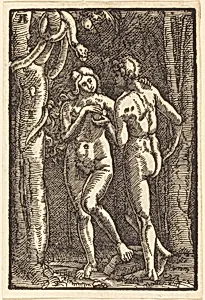
The Fall of Man
c. 1513
Medium
woodcut on laid paper
Dimensions
block: 7.2 × 4.9 cm (2 13/16 × 1 15/16 in.) sheet: 7.6 × 5.2 cm (3 × 2 1/16 in.)
Classification
Department
CG-E
Museum
National Gallery of Art, Washington, D.C.
Credit
Gift of W.G. Russell Allen
Accession Number
1941.1.109
Rights
Public Domain
Art Historical Context
Albrecht Altdorfer *The Fall of Man*, created around 1513, captures the biblical moment of Adam and Eveumbing to temptation in the Garden of Eden. This tiny woodcut on laid papermeasuring just 7.2 × 4.9 cm for the block—exempl the Northern Renaissance mastery of printmaking. Altdorfer, a pioneering figure in the Danube School infused his works with intricate landscapes and dramatic natural elements, even in miniature formats like this one, blending religious narrative with a profound sense of place. Woodcuts were revolutionary in the early 16th century, allowing artists to produce affordable, reproducible images that spread ideas across Europe amid the Reformation. Altdorfer's technique involved carving fine details into a wood block, inking it, and pressing it onto paper, yielding crisp lines and textures that evoke the lush, foreboding garden. The print's small scale suggests it may have been designed for devotional books or personal collections, making sacred stories accessible to everyday viewers. Today, housed in the National Gallery of Art as a gift from W.G. Russell Allen, this gem highlights Altdorfer's innovative fusion of spirituality and nature, offering a window into how Renaissance artists democratized art through prints.
About the Artist
Albrecht Altdorfer · 1475–1538
Albrecht Altdorfer (c. 1480–1538) was a German painter, printmaker, and draftsman who stands as one of the founders of landscape painting as an independent genre. Born in Regensburg or nearby Altdorf, he learned art from his father Ulrich, a painter and miniaturist. Altdorfer spent most of his life in Regensburg, becoming a citizen in 1505 and later serving as the city's official architect and a m...