
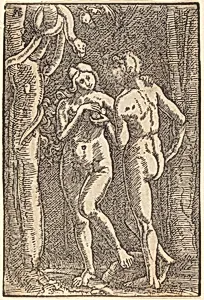
The Fall of Man
c. 1513
Medium
woodcut on laid paper
Dimensions
sheet (trimmed to block): 7.2 × 4.9 cm (2 13/16 × 1 15/16 in.)
Classification
Department
CG-E
Museum
National Gallery of Art, Washington, D.C.
Credit
Rosenwald Collection
Accession Number
1943.3.326
Rights
Public Domain
Art Historical Context
Albrecht Altdorfer's *The Fall of Man*, around 1513, captures the biblical story of Adam and Eve's from Eden in a remarkably intimate woodcut on laid paper. Measuring just 7.2 × 4.9 cm, this tiny print exemplifies the German Renaissance artist's mastery of the Danube School, a movement celebrated for its luminous landscapes and intricate details drawn from nature. Altdorfer, a pioneering printmaker and painter from Regensburg, infused religious narratives with dramatic, almost fantastical environments, blending spiritual allegory with observed reality. As a woodcut, the work showcases the technique's bold lines and tonal contrasts achieved through skilled carving into wooden blocks, allowing for multiple impressions that democratized art during the early 16th century. The trimmed sheet highlights its portability—ideal for personal devotion or collectors—while the fine laid paper preserves the crisp texture of Altdorfer's cross-hatching, evoking depth in such a minuscule format. Housed in the National Gallery of Art's Rosenwald Collection, this print reflects the era's fervor for biblical themes amid the eve of the Reformation, underscoring Altdorfer's role in elevating woodcuts from mere illustration to sophisticated art. Visitors will appreciate its delicate power, a window into Renaissance ingenuity.
About the Artist
Albrecht Altdorfer · 1475–1538
Albrecht Altdorfer (c. 1480–1538) was a German painter, printmaker, and draftsman who stands as one of the founders of landscape painting as an independent genre. Born in Regensburg or nearby Altdorf, he learned art from his father Ulrich, a painter and miniaturist. Altdorfer spent most of his life in Regensburg, becoming a citizen in 1505 and later serving as the city's official architect and a m...