
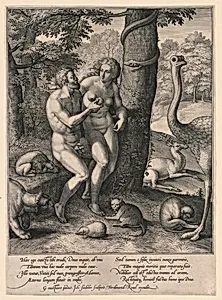
The Fall of Man
Classification
figures
Department
Smithsonian Collection
Museum
Smithsonian American Art Museum
Credit
Museum purchase through gift of various donors and from Eleanor G. Hewitt Fund
Accession Number
1938-88-8615
Rights
Public Domain
About this artwork
Research in Progress
Art Historical Context
**The Fall of Man** by Jan Sadeler the Elder (ca. 1550–1600) captures a pivotal biblical moment from the Book of Genesis: Adam and Eve's disobedience in the Garden of Eden, to their expulsion. Created around 1580, this work reflects the late Renaissance fascination with religious narratives, where artists explored human frailty and divine judgment through dramatic figures. Sadeler, a masterful Flemish engraver from a renowned family of printmakers, was celebrated for his intricate reproductions of paintings by masters like Hieronymus Bosch and Titian, blending Northern precision with Italianate grandeur. Though the medium remains under study, Sadeler's expertise in engraving suggests a focus on finely wrought lines to convey emotion and texture—shadowy foliage, expressive faces, and symbolic serpents that invite contemplation. Prints like this democratized art during the Reformation era, circulating moral lessons across Europe amid religious upheaval. Acquired through museum purchase and the Eleanor G. Hewitt Fund, it now graces the Smithsonian American Art Museum's collection of figures, underscoring the enduring dialogue between European traditions and American curatorial interests. As research progresses, this piece reminds us of art's power to probe humanity's timeless temptations.