
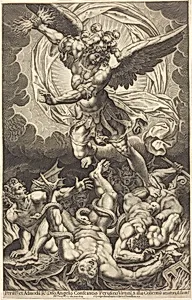
The Fall of the Rebellious Angels
Medium
engraving
Dimensions
sheet: 50.2 × 32.2 cm (19 3/4 × 12 11/16 in.)
Classification
Department
CG-E
Museum
National Gallery of Art, Washington, D.C.
Credit
Andrew W. Mellon Fund
Accession Number
1976.71.4
Rights
Public Domain
Art Historical Context
In the grand tradition of early 17th-century European printmaking, Philippe Thomin's *The Fall of the Reious Angels* (1618) captures a tumultuous biblical scene from the Book of Revelation, where Lucifer and his rebellious angels are hurled from heaven in a whirlwind of chaos and divine judgment. Created as an engraving—a meticulous intaglio technique where the artist incises fine lines into a metal plate hold ink—this work exemplifies the medium's power to convey intricate details and dramatic movement on paper. At 50.2 × 32.2 cm, its substantial sheet size allowed for bold compositions that rivaled paintings in impact. Thomassin, a skilled French engraver active during the transition from Mannerism to Baroque, produced prints that democratized religious iconography for a wider audience amid the Counter-Reformation's emphasis on spiritual fervor. Engravings like this were prized for their precision and reproducibility, enabling collectors and devotees to own vivid depictions of heavenly drama without accessing originals. Housed in the National Gallery of Art's Department of Prints (acquired via the Andrew W. Mellon Fund), this piece invites us to marvel at the era's fusion of technical virtuosity and theological intensity, reminding visitors of art's role in visualizing the unseen battles of the divine.