
The Family Party
published February 20, 1801
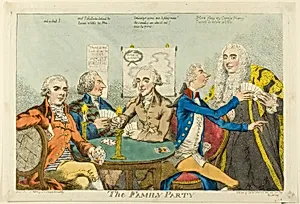
Medium
Hand-colored etching on ivory laid paper
Dimensions
Image: 22.2 × 33.8 cm (8 3/4 × 13 5/16 in.); Plate: 24.6 × 35 cm (9 11/16 × 13 13/16 in.); Sheet: 25.1 × 37 cm (9 15/16 × 14 5/8 in.)
Classification
etching
Department
Prints and Drawings
Museum
Art Institute of Chicago
Accession Number
89826
Rights
Public Domain
Art Historical Context
"The Family Party," a hand-colored etching by Charles Williams published on February 20, 1801, captures a lively domestic scene typical of early nineteenth-century British printmaking. Created during a period when satirical and genre prints flourished in London, the work reflects the era’s growing interest in everyday social interactions. Williams, active as a caricaturist, used the etching medium to reach a broad audience through affordable, reproducible images that often commented on contemporary life. The technique of etching on ivory laid paper, followed by delicate hand-coloring, was especially significant at the time. It allowed artists to combine precise line work with vibrant, individualized hues, transforming mass-produced prints into lively, collectible objects. Measuring roughly 22 by 34 centimeters in the image area, the composition balances intimate detail with clear narrative focus, inviting viewers to observe the subtle dynamics within the family gathering. Housed in the Prints and Drawings department at the Art Institute of Chicago, this work exemplifies how such etchings served both as entertainment and subtle social observation. Its warm palette and careful draftsmanship continue to offer modern visitors a window into the humor and customs of Regency-era Britain.
About the Artist
Charles Williams · 1797–1830
Charles Williams (1797–1830) was a British caricaturist and printmaker who worked in London during the final decades of the Georgian era, producing satirical prints for the thriving trade in political and social caricature that flourished in the city's print shops. He worked in the tradition established by such masters as James Gillray and Thomas Rowlandson, whose biting visual commentary on polit...