
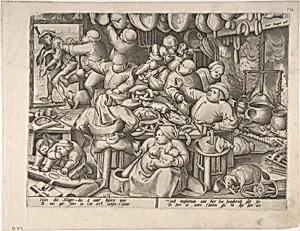
The Fat Kitchen
Medium
Engraving; first state
Dimensions
plate: 8 3/4 x 11 5/8 in. (22.2 x 29.5 cm) sheet: 10 1/4 x 13 1/4 in. (26.1 x 33.6 cm)
Classification
Prints
Department
Drawings and Prints
Museum
Metropolitan Museum of Art, New York, NY
Credit
Harris Brisbane Dick Fund, 1928
Accession Number
28.4(12)
Rights
Public Domain
Tags
Art Historical Context
**The Fat Kitchen**, an engraving from 1563, captures the masterful vision of Pieter Bruegel Elder, Northern Renaissance genius known for his vivid depictions of everyday life and subtle social satire. Designed by Bruegel and meticulously engraved by Pieter van der Heyden under publication of Hieronymus Cock, first-state print (plate: 8¾ × 11⅝ in.) exemplifies the collaborative artistry of 16th-century Antwerp workshops. As a print, it allowed Bruegel's intricate compositions to reach a wide audience beyond paintings, revolutionizing how genre scenes were disseminated during the Renaissance. The scene bursts with chaotic abundance in a crammed kitchen, featuring men, women—including female nudes—and lively animals amid piles of food and utensils. Bruegel contrasts this "fat" excess with his companion print *The Thin Kitchen*, poking fun at gluttony and the follies of human indulgence in an era of economic prosperity and moral preaching. The fine engraving technique shines through in the dense cross-hatching and minute details, creating depth and texture that mimic Bruegel's oil paintings. Housed in the Metropolitan Museum of Art's Drawings and Prints department (Harris Brisbane Dick Fund, 1928), this work highlights Bruegel's enduring influence on genre art, blending humor, humanity, and critique. Visitors will delight in its bustling energy, a window into 16th-century Flemish life.
About the Artist
Pieter Bruegel the Elder|Pieter van der Heyden|Hieronymus Cock · 1525–1569
Pieter Bruegel the Elder, a pioneering Netherlandish painter of the Renaissance, was born around 1525–1530, likely in Breda in the Duchy of Brabant (present-day Netherlands). Little is known of his early family background, but he apprenticed under the Antwerp painter and designer Pieter Coecke van Aelst between approximately 1545 and 1550, mastering tapestry design, architecture, and painting tech...