
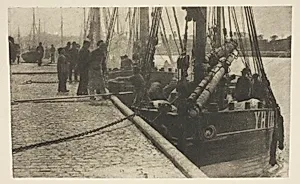
The First of the Herring
Medium
Photoetching, pl. XXVII from the album "Wild Life on a Tidal Water: The Adventures of a House-Boat and Her Crew" (1890)
Dimensions
Image: 9 × 14.8 cm (3 9/16 × 5 7/8 in.); Paper: 25 × 30 cm (9 7/8 × 11 13/16 in.)
Classification
photograph
Department
Photography and Media
Museum
Art Institute of Chicago
Accession Number
229759
Rights
Public Domain
Art Historical Context
Peter Henry Emerson's *The First of the Herring (1887), a photoetching from his 1890 album *Wild Life on a Tidal Water The Adventures of a Houseat and Her Crew*, the raw energy of coastal life on England's Norfolk Broads. Emerson, a pioneering British photographer, documented the daily rhythms of fishermen and houseboat dwellers, blending adventure narrative with vivid imagery. This intimate plate (XXVII), measuring just 9 × 14.8 cm on a larger 25 × 30 cm sheet, likely depicts the triumphant moment of a fresh herring catch, evoking the seasonal herring fishery that sustained local communities. As a photoetching—a photomechanical process translating photographic negatives into etched printing plates—Emerson elevated photography to fine art status. Rejecting staged portraits, he championed "naturalistic" techniques, using available light and candid moments to mimic impressionist painting. This work exemplifies his push for photography's artistic legitimacy in the late 19th century, bridging documentary realism with aesthetic beauty. Housed in the Art Institute of Chicago's Photography and Media Department, *The First of the Herring* offers a window into vanishing rural traditions, reminding us how Emerson's lens preserved the poetry of everyday labor amid tidal waters.
About the Artist
Peter Henry Emerson · 1856–1936
Peter Henry Emerson (1856–1936) was born on May 13 at his family's sugar plantation, La Palma Estate, near Encrucijada, Cuba, to an American father, Henry Ezekiel Emerson, and British mother, Jane Harris Billing. A distant relative of Ralph Waldo Emerson and Samuel Morse, he spent his early childhood amid the island's landscapes before moving to Wilmington, Delaware, during the American Civil War ...