
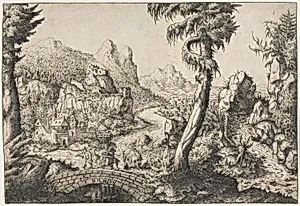
The Flight into Egypt
1558
Medium
Etching on paper
Dimensions
19.2 × 27.9 cm (7 9/16 × 11 in.)
Classification
etching
Department
Prints and Drawings
Museum
Art Institute of Chicago
Accession Number
78624
Rights
Public Domain
Art Historical Context
### The Flight into Egypt Hanns Lautensack, a Nuremberg-based German printmaker active in the mid-16th century, created *The Flight into Egypt* in 1558. This etching a pivotal biblical scene from the Gospel of Matthew: the Holy Family—Mary cradling the infant Jesus, with Joseph guiding their donkey—fleeing Herod's massacre of the innocents. Lautensack, influenced by the detailed precision of Albrecht Dürer and the Nuremberg school, infused his works with intricate landscapes and narrative depth, blending religious devotion with emerging interest in nature. Etching on paper, measuring a intimate 19.2 × 27.9 cm, was a revolutionary technique by the 1550s, allowing artists like Lautensack freer, more spontaneous lines than traditional engraving. The medium's tonal richness brought atmospheric drama to the nocturnal journey, highlighting the vulnerability of the figures amid rugged terrain—a nod to Northern Renaissance printmaking's role in disseminating art to wider audiences beyond wealthy patrons. Housed in the Art Institute of Chicago's Prints and Drawings Department, this work exemplifies the era's fusion of faith and artistry during the Protestant Reformation. Its survival as a finely preserved etching underscores the enduring cultural importance of such prints in preserving sacred stories for everyday contemplation.
About the Artist
Hanns Lautensack · 1515–1566
Hanns Lautensack, born in 1524 in Bamberg, Germany, was the son of Paul Lautensack, a noted painter and organist. Alongside his brother Heinrich, a goldsmith, the family relocated to Nuremberg in 1527, where Hanns immersed himself in the vibrant artistic milieu of the city. There, he likely apprenticed with a goldsmith, honing skills in fine metalwork that informed his precise etching technique, t...