
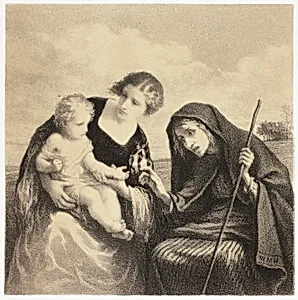
The Fortune Teller
Medium
Lithograph with a brown tone on ivory wove paper
Dimensions
Image: 19 × 18.9 cm (7 1/2 × 7 1/2 in.); Sheet: 37.9 × 30.9 cm (14 15/16 × 12 3/16 in.)
Classification
lithograph
Department
Prints and Drawings
Museum
Art Institute of Chicago
Accession Number
117786
Rights
Public Domain
Art Historical Context
William Morris Hunt’s “The Fortune Teller” of 1857 showcases the artist’s engagement with lithography, a medium that gained prominence in the nineteenth century for its ability to produce rich, tonal effects at relatively low cost. Printed in warm brown ink on ivory wove paper, the work demonstrates how the lithographic process—drawing directly on a prepared stone—could capture subtle gradations and a sense of intimacy usually associated with drawings. Measuring just under eight inches square for the image, the print was likely intended for wider circulation than a unique painting, reflecting the era’s growing interest in making art more accessible to middle-class collectors. Housed today in the Art Institute of Chicago’s department of Prints and Drawings, the sheet’s generous margins and careful registration highlight the technical care taken in its production. As a lithograph rather than an oil painting, it represents Hunt’s exploration of reproductive media at a moment when American artists were looking to European print traditions while seeking distinctly modern subjects. The title alone invites viewers to imagine the narrative scene, yet the restrained palette and graphic clarity keep attention on the interplay of light, shadow, and line that lithography renders so effectively. This modest yet finely crafted print thus bridges Hunt’s larger reputation as a painter with the democratic potential of printmaking, offering museum visitors a glimpse into both artistic technique and the changing landscape of art distribution in antebellum America.
About the Artist
William Morris Hunt · 1824–1879
American, Brattleboro, Vermont 1824–1879 Appledore, New Hampshire