
The Garden
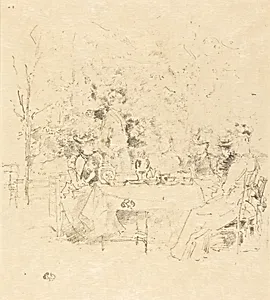
Medium
lithograph in black on wove paper
Dimensions
image: 17 × 18.5 cm (6 11/16 × 7 5/16 in.) sheet: 31.6 × 20 cm (12 7/16 × 7 7/8 in.)
Classification
Department
CG-W
Museum
National Gallery of Art, Washington, D.C.
Credit
Rosenwald Collection
Accession Number
1943.3.8697
Rights
Public Domain
Art Historical Context
James McNeill Whistler's *The Garden* (1891) is a masterful lithograph in black on wove paper, capturing artist's refined sensitivity to tone and form. Measuring just 17 × 18.5 cm for the image on a larger 31.6 × 20 cm sheet, this intimate print invites close contemplation, evoking Whist lifelong pursuit of harmonious compositions. Housed in the National Gallery Art's Rosenwald Collection it exemplifies the Classification of Print within the CG-W Department. istler, a pivotal figure the Aesthetic movement, championed "art for art's sake," prioritizing subtle beauty over narrative. By 1891, he had honed lithography—a planographic technique using greasy crayon on stone to yield fluid, painterly effects—as a democratic medium to share his vision beyond oil paintings. This black-ink process on smooth wove paper allowed velvety gradations, mirroring the atmospheric nocturnes and Thames scenes for which he was renowned. *The Garden* reflects Whistler's innovative printmaking during his later career, bridging fine art and reproduction. Its modest scale and monochromatic elegance highlight his technical prowess, influencing modern graphic arts and underscoring prints' role in 19th-century cultural exchange. A gem for collectors, it reminds us of gardens as timeless symbols of serenity.
About the Artist
James McNeill Whistler · 1834–1903
James Abbott McNeill Whistler (1834-1903) was an American-born painter and printmaker who became a leading figure in the Aesthetic Movement and pioneer of Tonalism and Japonisme. He revolutionized art by championing "art for art's sake" and treating paintings as visual equivalents of musical compositions, titling works as "arrangements," "harmonies," and "nocturnes" to emphasize formal qualities o...