
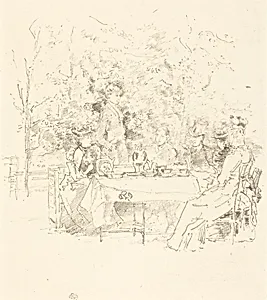
The Garden
Medium
lithograph in black on wove paper
Dimensions
image: 17 × 18.5 cm (6 11/16 × 7 5/16 in.) sheet: 30.9 × 21.3 cm (12 3/16 × 8 3/8 in.)
Classification
Department
CG-W
Museum
National Gallery of Art, Washington, D.C.
Credit
Rosenwald Collection
Accession Number
1943.3.8698
Rights
Public Domain
Art Historical Context
### The Garden Step into the serene world of James McNeill Whistler’s *The Garden* (1891), a lithograph in black on wove paper, measuring just 17 × 18.5 cm. Created during the artist’s mature phase, this intimate print captures Whistler’s signature pursuit of harmony and atmosphere, evoking the Aesthetic movement’s mantra of “art for art’s sake Part of the National Gallery of Art’s Rosen Collection in the Prints department it exemplifies his late-19th-century experimentation with printmaking as a democratic medium, allowing subtle tonal gradations akin to his famed oil nocturnes. Whistler, an American expatriate in London, revolutionized lithography by treating it like painting—using greasy crayon on limestone to draw fluid lines and soft veils of tone directly on the stone. This technique on smooth wove paper produced velvety blacks and luminous whites, inviting viewers to savor mood over narrative. By 1891, after triumphs like the 1877 libel trial against critic John Ruskin, Whistler had cemented his influence on modern art, bridging Impressionism and Symbolism. A gem for print enthusiasts, *The Garden* whispers of enclosed, dreamlike spaces—perhaps a London nook or imagined Eden—reminding us how Whistler distilled beauty into everyday elegance. Gaze closely; its modest scale belies profound poetic depth.
About the Artist
James McNeill Whistler · 1834–1903
James Abbott McNeill Whistler (1834-1903) was an American-born painter and printmaker who became a leading figure in the Aesthetic Movement and pioneer of Tonalism and Japonisme. He revolutionized art by championing "art for art's sake" and treating paintings as visual equivalents of musical compositions, titling works as "arrangements," "harmonies," and "nocturnes" to emphasize formal qualities o...