
The Genius of Castiglione
Medium
Etching
Dimensions
sheet: 17 13/16 x 14 3/4 in. (45.2 x 37.5 cm)
Classification
Prints
Department
Drawings and Prints
Museum
Metropolitan Museum of Art, New York, NY
Credit
Gift of Robert L. Manning and Bertina Suida Manning, 1979
Accession Number
1979.508
Rights
Public Domain
Tags
Art Historical Context
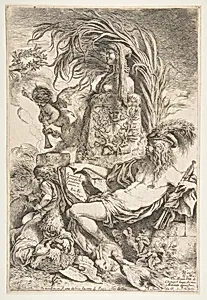
Welcome to *The Genius of Castiglione a captivating etching created around 1645–47 by the Baroque Giovanni Benedetto Castiglione, as Il Grechetto, and published in 1648 by Giovanni Giacomo De Rossi and Matth van de Merwede. Housed in the Metropolitan Museum of Art Drawings and Prints department, this sheet (17 13/16 x 14 3/4 inches) exemplifies the innovative spirit of 17th-century Italian printmaking. Castiglione, a Genoese artist celebrated for his dynamic compositions blending painting and graphics, used etching—a technique where acid etches intricate lines into a metal plate—to produce works that rivaled the richness of oil paintings. The print buzzes with life through its tags of musical instruments, expressive faces, men, and women, suggesting an allegorical celebration of artistic genius. Putti or ethereal figures likely frolic amid lutes, violins, and other instruments, embodying creativity and harmony in true Baroque fashion—dramatic, theatrical, and infused with movement. Castiglione's virtuoso linework captures fleeting expressions and textured details, making this a standout in his rare but influential print oeuvre. As a 1979 gift to the Met from Robert L. Manning and Bertina Suida Manning, it highlights printmaking's role in democratizing art during the Counter-Reformation era, allowing Castiglione's genius to reach collectors across Europe. A delightful window into 17th-century imagination!
About the Artist
Giovanni Benedetto Castiglione (Il Grechetto)|Giovanni Giacomo De Rossi|Matthys van de Merwede, Lord of Clootwyck · 1609–1664
Giovanni Benedetto Castiglione, known as Il Grechetto, was baptized on March 23, 1609, in Genoa and died on May 5, 1664, in Mantua. Born into a large family, he collaborated closely with his brother Salvatore, an artist who shared his talents, and later taught his son Francesco, whose works were sometimes confused with his own. His parents placed him in the studio of Giovanni Battista Paggi, where...