
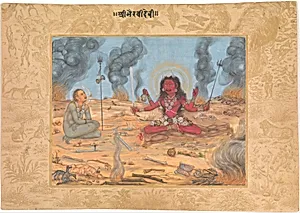
The Goddess Bhairavi Devi with Shiva
ca. 1630–35
Medium
Opaque watercolor and gold on paper
Dimensions
H. 7 1/4 in. (18.5 cm) W. 10 3/8 in. (26.5 cm)
Classification
Codices
Department
Islamic Art
Museum
Metropolitan Museum of Art, New York, NY
Credit
Purchase, Lila Acheson Wallace Gift, 2011
Accession Number
2011.409
Rights
Public Domain
Tags
Art Historical Context
In the opulent world of 17th-century Mughal India Payag, a master painter in the imperial atelier, created *The Goddess Bhairavi with Shiva* around 1630–35. This exquisite opaque watercolor and gold on paper measures just 7¼ by 10⅜ inches, a hallmark of the intimate Mughal miniature tradition. Rendered with luminous gold accents and vibrant pigments, it captures the fierce tantric goddess Bhairavi— a powerful form of the Divine Mother—alongside Shiva, encircled by motifs of skulls and flames symbolizing destruction and transformation. Produced during Emperor Shah Jahan's reign, the artwork reflects the Mughal court's eclectic patronage, blending Hindu iconography with Persianate finesse. Payag's precise linework and jewel-like colors evoke the divine energy (shakti) of Bhairavi, one of the ten Mahavidyas, embodying raw cosmic power. Classified as a codex leaf in the Metropolitan Museum of Art's Islamic Art Department, it highlights how Mughal artists bridged religious traditions, illustrating esoteric themes for elite connoisseurs. This piece showcases innovative techniques like burnished gold for ethereal glows and intricate detailing of fiery auras and skeletal emblems, inviting viewers to contemplate the balance of creation and annihilation in Hindu cosmology. A testament to Payag's skill, it remains a vibrant window into India's spiritual and artistic heritage.