
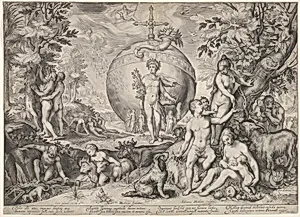
The Golden Age
Medium
Engraving
Dimensions
sheet: 12 3/16 x 16 3/4 in. (30.9 x 42.6 cm)
Classification
Prints
Department
Drawings and Prints
Museum
Metropolitan Museum of Art, New York, NY
Credit
Bequest of Phyllis Massar, 2011
Accession Number
2012.136.900
Rights
Public Domain
Tags
Art Historical Context
**The Golden Age** (1620) is a captivating engraving produced through a remarkable collaboration among Dutch masters Hendrick Goltzius, Adriaen Matham, Matham, and poet Theodorus Schrevelius Measuring 12 3/16 x 16 3/4 inches, this print from the Metropolitan Museum of Art's Drawings and department vividly depicts an idyllic pastoral paradise. Graceful male and female nudes frolic amid cows, goats, dogs, and playful infants in a lush landscape, evoking the classical myth of the Golden Age—a utopian era of harmony abundance, and innocence drawn from Ovid's *Metoses*. Goltzius, a leading figure in Northern Mannerism, likely designed the composition, known for his dynamic poses and muscular figures, while the Mathams executed the intricate engraving technique. This burin method allowed for precise, shimmering lines that captured light, texture, and movement, making prints like this highly prized reproductions of grand inventions. Such works bridged painting and printmaking, disseminating Renaissance ideals across Europe. Entered the Met's collection via the 2011 bequest of Phyllis Massar, *The Golden Age* reflects early 17th-century Dutch fascination with classical antiquity and nature's bounty. It invites viewers to ponder humanity's lost Eden, blending eroticism, whimsy, and allegory in a timeless celebration of unspoiled joy.