
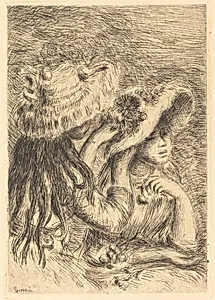
The Hat Pin (Le chapeau epingle)
1894
Medium
drypoint
Classification
Department
CG-E
Museum
National Gallery of Art, Washington, D.C.
Credit
Gift of Mr. and Mrs. Sam R. Broadbent
Accession Number
1979.35.3
Rights
Public Domain
Art Historical Context
**The Hat Pin (Le épingle)**, created by Auguste Renoir in1894, captures the artist's masterful transition from luminous Impressionist canvases to the intimate world of printmaking. Renoir, a leading figure in the Impressionist celebrated for his vibrant depictions of everyday life and feminine grace, produced this drypoint during a period of experimentation in his later career. The work reflects the Belle Époque's fascination with fashion and portraiture, likely portraying a stylish woman adorned with the titular hat pin—a practical yet decorative accessory symbolizing refined Parisian elegance. Drypoint, an intaglio technique where Renoir scratched directly into a copper plate with a sharp tool, yields richly textured lines and a soft, velvety burr that mimics the fluidity of his brushstrokes. Unlike etching's precise acid lines, drypoint allowed for spontaneous, expressive marks, showcasing Renoir's exceptional draftsmanship and sensitivity to light and form. This rarity among his prints highlights his versatility beyond oil painting. Generously gifted to the National Gallery of Art by Mr. and Mrs. Sam R. Broadbent, *The Hat Pin* invites visitors to appreciate how Renoir bridged Impressionism's spontaneity with the meticulous craft of printmaking, offering a window into 1890s cultural sophistication. (198 words)
About the Artist
Auguste Renoir · 1841–1919
Pierre-Auguste Renoir (1841-1919) was a founding figure of Impressionism whose luminous depictions of Parisian leisure, sensuous female forms, and sun-dappled landscapes made him one of the most beloved painters in Western art history. Born in Limoges to a working-class family, Renoir began as a porcelain painter before pursuing fine arts, and this early craft experience gave him facility with the...