
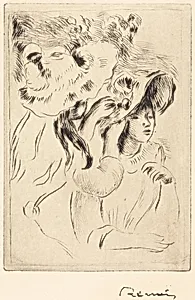
The Hat Pin (Le chapeau epingle)
1894
Medium
drypoint on wove paper
Classification
Department
CG-E
Museum
National Gallery of Art, Washington, D.C.
Credit
Rosenwald Collection
Accession Number
1946.21.318
Rights
Public Domain
Art Historical Context
**The Hat Pin (Le chapeauingle)**, created by Auguste Renoir in 1894, is a exquisite drypoint print on wove paper, housed in the National Gallery of's Rosenwald Collection (Department CG-E). Renoir, the celebrated French Impressionist best known for his vibrant paintings of everyday life and luminous portraits, ventured into printmaking during the1890s. This showcased his extraordinary draughtsmanship in a more intimate, experimental medium, bridging his painterly style with the precision of graphic arts. Drypoint technique involves scratching directly into a metal plate with a sharp needle, raising a soft burr that produces velvety, expressive lines—ideal for capturing texture and light. Unlike his oil paintings, this print emphasizes line quality and subtle tonal effects, reflecting Renoir's late-career fascination with etching and drypoint. Produced at the height of fin-de-siècle Parisian culture, it evokes the elegance of women's fashion, with the hat pin symbolizing refined femininity. As a rare print by a master Impressionist, **The Hat Pin** highlights Renoir's versatility and the growing prestige of original prints among collectors. Its inclusion in the esteemed Rosenwald Collection affirms its artistic significance, offering visitors a glimpse into the technical innovation and charm that defined Renoir's enduring legacy. (198 words)
About the Artist
Auguste Renoir · 1841–1919
Pierre-Auguste Renoir (1841-1919) was a founding figure of Impressionism whose luminous depictions of Parisian leisure, sensuous female forms, and sun-dappled landscapes made him one of the most beloved painters in Western art history. Born in Limoges to a working-class family, Renoir began as a porcelain painter before pursuing fine arts, and this early craft experience gave him facility with the...