
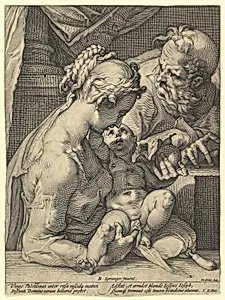
The Holy Family
Medium
Engraving
Classification
Prints
Department
Drawings and Prints
Museum
Metropolitan Museum of Art, New York, NY
Credit
Harris Brisbane Dick Fund, 1953
Accession Number
53.601.336(9)
Rights
Public Domain
Tags
Art Historical Context
**The Holy Family** by Hendrick Goltzius is a captivating engraving that brings the sacred trio of the Virgin Mary, the infant Jesus, and Saint Joseph to life with exquisite detail. Goltzius (1558–1617), a leading artist of the Mannerist period, was renowned for his masterful printmaking, blending intricate line work with dramatic poses and emotional depth. This undated work exemplifies his ability to elevate religious subjects into visually compelling narratives, drawing viewers into the tender intimacy of the Holy Family motif central to Christian devotion during the late Renaissance. As an engraving, the piece showcases Goltzius' technical brilliance: he incised fine lines into a metal plate, creating rich textures and tonal contrasts when inked and printed. This medium was revolutionary for its time, allowing widespread dissemination of high-art images to collectors and the faithful across Europe. Housed in the Metropolitan Museum of Art's Drawings and Prints department (acquired via the Harris Brisbane Dick Fund in 1953), it reflects the enduring cultural importance of such prints in preserving Mannerist elegance and spiritual iconography. Today, *The Holy Family* invites us to appreciate not just its piety, but Goltzius' innovative fusion of engraving's precision with painterly grandeur— a testament to how prints bridged art and devotion in the 16th century.
About the Artist
Hendrick Goltzius · 1558–1617
Hendrick Goltzius (1558–1617) was the most celebrated engraver of the Northern Renaissance and a pivotal figure in Dutch Mannerism. Born near the German-Dutch border, Goltzius transformed printmaking into a virtuoso art form through his revolutionary 'swelling line' technique, where the burin was manipulated to create lines of varying thickness that produced unprecedented tonal effects and three-d...