
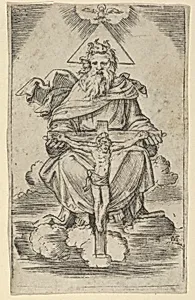
The Holy Trinity
ca. 1500–27
Medium
Engraving
Dimensions
3 5/16 x 2 in. (8.4 x 5.1 cm)
Classification
Prints
Department
Drawings and Prints
Museum
Metropolitan Museum of Art, New York, NY
Credit
The Elisha Whittelsey Collection, The Elisha Whittelsey Fund, 1949
Accession Number
49.97.47
Rights
Public Domain
Tags
Art Historical Context
Marcantonio Raimondi’s *The Holy Trinity*, exquisite engraving from around 1500–1527, captures the profound Christian doctrine of the Father, Son, and Holy Spirit in a compact 3 5/16 x 2-inch format. As one of the Renaissance’s premier engravers, Raimondi (c. 1480–1534) mastered the burin technique, incising fine lines into copper plates to produce intricate, tonal images that rivaled paintings. Working in Italy during the High Renaissance, he reproduced designs by masters like Raphael, making sacred art accessible beyond elite patrons through affordable prints. This devotional work depicts God the Father supporting the crucified Christ, with the Holy Spirit likely symbolized above, embodying the Trinity’s unity amid suffering. Engravings like this were revolutionary, democratizing religious imagery during a time of spiritual fervor and the early Reformation. Raimondi’s precise linework conveys depth, emotion, and divine light, influencing printmaking across Europe. Housed in the Metropolitan Museum of Art’s Drawings and Prints department, this piece from The Elisha Whittelsey Collection highlights how small-scale prints carried immense cultural weight, bridging art, faith, and innovation in the 16th century.
About the Artist
Marcantonio Raimondi · 1475–1534
Marcantonio Raimondi (c. 1480–1534), born near Bologna, Italy, emerged as one of the Renaissance's premier engravers, revolutionizing printmaking through his mastery of reproductive techniques. He trained in the workshop of the goldsmith, painter, and niellist Francesco Francia, whose influence is evident in his early engravings, such as the goldsmith-like shading in *Pyramus and Thisbe* (1505), h...