
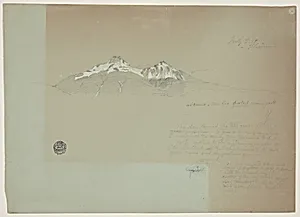
The Illinizas, Ecuador
July 3, 1857
Classification
landscapes
Department
Smithsonian Collection
Museum
Smithsonian American Art Museum
Credit
Gift of Louis P. Church
Accession Number
1917-4-259
Rights
Public Domain
About this artwork
Research in Progress
Art Historical Context
Frederic Edwin Church, a leading figure of the Hudson River School, the majestic Illinizas volcanoes in Ecuador this landscape on July 3, 1857. Painted during one of Church's expeditions to South America, the work reflects his passion for documenting the raw power and beauty of nature. As an American artist (1826–1900), Church traveled extensively, sketching en plein air to convey the sublime scale of exotic landscapes, inspired by explorer Alexander von Humboldt's scientific writings. This piece exemplifies Church's meticulous observation of light, atmosphere, and geological drama, hallmarks of the luminist style within the Hudson River School. Though the medium remains unidentified amid ongoing research, its classification as a landscape underscores Church's role in elevating American art through vivid portrayals of the New World's wonders. Donated by his son Louis P. Church, it now resides in the Smithsonian American Art Museum's Smithsonian Collection. Church's Ecuadorian studies, including this on-site creation, fueled masterpieces like *The Heart of the Andes* (1859), bridging Romanticism and emerging scientific curiosity. For visitors, it offers a window into 19th-century exploration and the artist's quest to immortalize nature's grandeur. (198 words)