
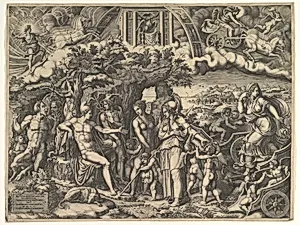
The Judgment of Paris
Medium
Engraving; third state of three (BLL)
Dimensions
Sheet (Trimmed): 16 in. × 21 1/4 in. (40.7 × 54 cm)
Classification
Prints
Department
Drawings and Prints
Museum
Metropolitan Museum of Art, New York, NY
Credit
The Elisha Whittelsey Collection, The Elisha Whittelsey Fund, 1963
Accession Number
63.517.27
Rights
Public Domain
Tags
Art Historical Context
Created in 1555, *The Judgment of Paris* captures the pivotal moment from Greek mythology when the Trojan prince Paris awards a golden apple to Venus, setting in motion the events of the Trojan War. This large engraving resulted from a collaboration between Italian designer Giovanni Battista Bertano, renowned engraver Giorgio Ghisi, and publisher Hieronymus Cock. The composition teems with nude figures, playful putti, and mythological creatures such as satyrs, all arranged around chariots and classical architecture to convey both drama and sensuality. As an engraving, the work exemplifies the 16th-century printmaking techniques that allowed complex compositions to reach wide audiences across Europe. Ghisi’s precise line work translates the original design into intricate patterns of light and shadow, characteristic of the period’s interest in reproducing paintings and sculptures through print. Issued in multiple states, this third state reflects the evolving tastes of collectors who valued refined impressions of mythological subjects. Housed today in the Metropolitan Museum of Art, the print highlights how Renaissance artists reinterpreted ancient stories to explore ideals of beauty, judgment, and desire. Its impressive scale and rich detail continue to invite viewers to appreciate both the technical mastery of engraving and the enduring power of classical narrative.
About the Artist
Giorgio Ghisi|Giovanni Battista Bertano|Hieronymus Cock · 1520–1582
Giorgio Ghisi (c. 1520–1582) was one of the most accomplished engravers of the Italian Renaissance, renowned for translating the monumental compositions of Raphael, Giulio Romano, and Michelangelo into the exacting medium of the burin. Born in Mantua, he trained in an environment shaped by the legacy of Giulio Romano's decoration of the Palazzo del Te, and the grandeur of that Mannerist tradition ...