
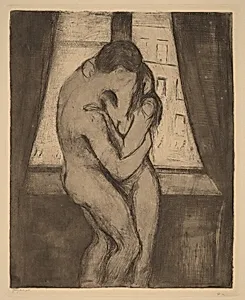
The Kiss (Der Kuss)
1895
Medium
drypoint and aquatint
Classification
Department
CG-E
Museum
National Gallery of Art, Washington, D.C.
Credit
Rosenwald Collection
Accession Number
1944.14.62
Rights
Public Domain
Art Historical Context
Edvard Munch’s *The Kiss* (1895) captures one of the Norwegian artist’s most enduring motifs: two figures locked in an intimate embrace. Created during a pivotal period when Munch was living between Berlin and Paris, the print belongs to his broader exploration of love, desire, and emotional intensity that would later form part of his “Frieze of Life” series. Though best known for paintings such as *The Scream*, Munch frequently revisited this subject across paintings, drawings, and prints, distilling human connection to its most essential, almost abstract form. Executed in drypoint and aquatint, the work showcases Munch’s innovative approach to printmaking. Drypoint’s velvety lines and aquatint’s tonal washes allowed him to achieve rich contrasts and a sense of mystery without relying on color. The resulting image merges the two figures into a single, shadowy shape, emphasizing emotional fusion over individual identity—an effect heightened by the medium’s soft, atmospheric textures. As part of the National Gallery of Art’s Rosenwald Collection, this impression highlights Munch’s importance in the development of modern printmaking and Expressionist art. Visitors often find the work both tender and unsettling, reflecting the artist’s lifelong interest in the psychological complexities of love.
About the Artist
Edvard Munch · 1863–1944
Edvard Munch (1863-1944) was a Norwegian painter and printmaker whose intensely psychological works made him a pioneer of Expressionism and one of the most influential artists of the modern era. His 1893 masterpiece 'The Scream' has become an iconic symbol of existential anxiety. Munch's art was profoundly shaped by personal tragedy—his mother died when he was five, his beloved sister Sophie at fo...