
The Last Judgment
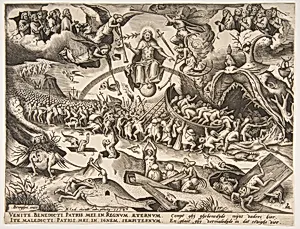
Medium
Engraving; first state of two
Dimensions
sheet: 8 15/16 x 11 11/16 in. (22.7 x 29.7 cm)
Classification
Prints
Department
Drawings and Prints
Museum
Metropolitan Museum of Art, New York, NY
Credit
Harris Brisbane Dick Fund, 1926
Accession Number
26.72.32
Rights
Public Domain
Tags
Art Historical Context
**The Last Judgment** (1558) is a striking engraving designed by the renowned Netherlandish artist Pieter Bruegel the Elder, with engraving by Pieter van der Heyden and publication by Hieronymus Cock. This first-state impression—measuring 8 15/16 x 11 11/16 inches—captures Bruegel's vision of the biblical apocalypse, where the heavens split open amid swirling chaos, angels trumpet the end of days, and souls face divine reckoning. Housed in the Metropolitan Museum of Art's Drawings and Prints department (Harris Brisbane Dick Fund, 1926), it exemplifies the collaborative printmaking of Renaissance Antwerp workshops. Bruegel, a master of the Northern Renaissance, infused his works with intricate details, moral allegory, and a touch of the grotesque, blending landscape grandeur with human drama. Created during the turbulent Reformation era, when religious upheaval gripped Europe, this print reflects anxieties over salvation and judgment, making complex theology accessible through vivid imagery. Engravings like this were revolutionary, allowing Bruegel's innovative style—crowded with hundreds of tiny figures—to reach a wide audience beyond paintings. As a "first state," this rare early version preserves untouched lines before later alterations, offering insight into the meticulous refinement process. Visitors will appreciate its technical precision and enduring cultural resonance, a window into 16th-century fears and artistic brilliance.
About the Artist
Pieter Bruegel the Elder|Pieter van der Heyden|Hieronymus Cock · 1525–1569
Pieter Bruegel the Elder, a pioneering Netherlandish painter of the Renaissance, was born around 1525–1530, likely in Breda in the Duchy of Brabant (present-day Netherlands). Little is known of his early family background, but he apprenticed under the Antwerp painter and designer Pieter Coecke van Aelst between approximately 1545 and 1550, mastering tapestry design, architecture, and painting tech...