
The Last Judgment
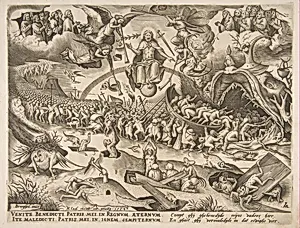
Medium
Engraving; first state of two
Dimensions
sheet: 10 1/4 x 13 9/16 in. (26 x 34.4 cm)
Classification
Prints
Department
Drawings and Prints
Museum
Metropolitan Museum of Art, New York, NY
Credit
Harris Brisbane Dick Fund, 1928
Accession Number
28.4(36)
Rights
Public Domain
Tags
Art Historical Context
Welcome to the Metropolitan Museum of Art's Drawings and Prints department, where Pieter Bruegel the Elder's *The Last Judgment* (8) captivates its dramatic vision of apocalypse. Designed by the renowned Northern Renaissance master Bruegel, known for intricate, morally charged landscapes and crowd scenes, this engraving was meticulously executed by Pieter van derden and published by Hieronymus Cock. Depicting the biblical Last Judgment it swirls with chaotic figures rising from graves, angels trumpeting, and the divine divide between saved souls and the damned— a vivid reflection of 16th-century Catholic anxieties amid the Protestant Reformation. As a first-state engraving on a modest sheet (10 1/4 x 13 9/16 in.), this print exemplifies the era's innovative reproductive techniques. Engraving's fine lines allowed Bruegel's teeming details—tiny sinners tumbling into hellfire alongside ethereal heavens—to reach wide audiences beyond paintings, making complex theology accessible to the masses. This collaborative print series was a commercial hit, blending Bruegel's satirical edge with technical precision. Acquired through the Harris Brisbane Dick Fund in 1928, *The Last Judgment* endures as a testament to Renaissance printmaking's cultural power, inviting us to ponder eternity amid its whirlwind of human fate.
About the Artist
Pieter Bruegel the Elder|Pieter van der Heyden|Hieronymus Cock · 1525–1569
Pieter Bruegel the Elder, a pioneering Netherlandish painter of the Renaissance, was born around 1525–1530, likely in Breda in the Duchy of Brabant (present-day Netherlands). Little is known of his early family background, but he apprenticed under the Antwerp painter and designer Pieter Coecke van Aelst between approximately 1545 and 1550, mastering tapestry design, architecture, and painting tech...