
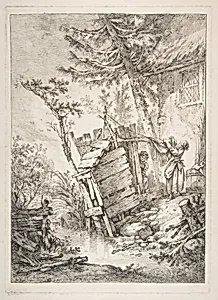
The Laundress
1756
Medium
Etching; first state of two
Dimensions
image: 11 5/8 x 8 7/16 in. (29.6 x 21.4 cm) plate: 12 3/8 x 8 3/4 in. (31.5 x 22.3 cm) sheet: 18 7/8 x 13 3/4 in. (48 x 35 cm)
Classification
Prints
Department
Drawings and Prints
Museum
Metropolitan Museum of Art, New York, NY
Credit
The Elisha Whittelsey Collection, The Elisha Whittelsey Fund, 1955
Accession Number
55.503.31
Rights
Public Domain
Tags
Art Historical Context
François Boucher's *The Laundress* (1756) is a delicate etching from the first state two, capturing the Rococo master's signature elegance in print form. Measuring about 11⅝ × 8½ inches, this work belongs to the Metropolitan Museum of Art's Drawings and Prints department, gifted through The Elisha Whittelsey Collection.oucher, a leading French artist of the 18th century and favorite of Madame de Pompad, was renowned for his playful, sensual depictions of everyday life infused with mythological grace. As an etching—a technique where acid etches intricate lines into a metal plate—this print exemplifies Boucher's skill in translating his fluid, ornamental style to a reproducible medium. Rococo art, flourishing in Louis XV's courtly France, emphasized lightness, asymmetry, and delight in the senses, often idealizing women in pastoral or domestic scenes. Here, the laundress embodies this ethos: a working woman rendered with poise and allure, elevating humble labor into something poetic and refined. This piece reflects broader cultural fascinations with feminine labor during the Enlightenment era, blending realism with fantasy. Prints like this made Boucher's opulent world accessible beyond elite patrons, influencing fashion, décor, and later Romantic artists. A charming window into 18th-century frivolity!
About the Artist
François Boucher · 1703–1770
François Boucher (1703–1770) stands as the quintessential master of French Rococo painting and the most celebrated decorative artist of the 18th century. Born in Paris to a lace designer, Boucher created a visual language that perfectly embodied the refined taste, sensuality, and elegance of Louis XV's court. His prolific output—encompassing paintings, tapestry designs, theatrical sets, and decora...