
The Little Hunchback
17th century
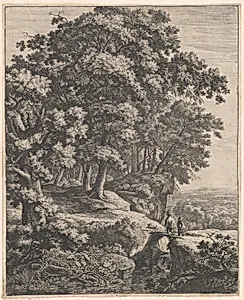
Medium
Etching; third state of three
Dimensions
sheet: 11 1/2 x 9 1/4 in. (29.2 x 23.5 cm)
Classification
Prints
Department
Drawings and Prints
Museum
Metropolitan Museum of Art, New York, NY
Credit
Harris Brisbane Dick Fund, 1947
Accession Number
47.100.14
Rights
Public Domain
Tags
Art Historical Context
Anthonie Waterloo’s *The Little Hunchback* is a delicate etching created in the seventeenth century, during the height of the Dutch Golden Age. Waterloo, a Flemish-born artist who worked primarily in the Netherlands, specialized in landscape prints that captured the quiet poetry of the countryside. This impression, the third and final state of the plate, reveals the artist’s careful revisions to balance light and shadow across the scene. The composition centers on a solitary figure crossing a rustic bridge amid dense trees, inviting viewers to pause and consider the relationship between humans and nature. Etching allowed Waterloo to achieve fine, expressive lines that convey both texture and atmosphere, a technique prized by collectors for its immediacy and tonal subtlety. Acquired by the Metropolitan Museum through the Harris Brisbane Dick Fund in 1947, the print exemplifies how Dutch artists transformed ordinary rural motifs into enduring works of art.
About the Artist
Anthonie Waterloo · 1609–1690
Anthonie Waterloo (1609–1690) was a prominent Dutch Golden Age landscape artist, born on May 6 in Lille, then part of the Spanish Netherlands. Little is known of his early life beyond his mother, Magdalena Vaillant, who joined Amsterdam's Walloon Church in 1621, with Waterloo following in 1630; no records exist of formal training, and he was likely self-taught. Registered as a painter in Amsterdam...