
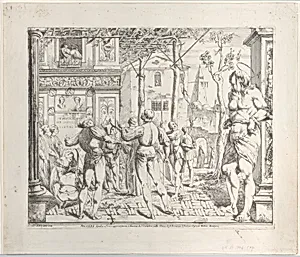
The Martyrdom of Saint Christopher, "Secondo Quadro"
Medium
Etching; second state
Dimensions
Plate: 12 13/16 × 15 11/16 in. (32.5 × 39.8 cm) Sheet: 15 11/16 × 18 1/2 in. (39.9 × 47 cm)
Classification
Prints
Department
Drawings and Prints
Museum
Metropolitan Museum of Art, New York, NY
Credit
A. Hyatt Mayor Purchase Fund, Marjorie Phelps Starr Bequest, 1992
Accession Number
1992.1056
Rights
Public Domain
Art Historical Context
Behold *The Martyrdom of Saint Christopher, "Secondo Quadro"*, a striking etching from 1776 by Giovanni David, reproducing a composition attributed to the Renaissance master Andrea Mantegna. This second-state impression captures the dramatic martyrdom of Saint Christopher, the beloved giant patron saint of travelers, known in legend for carrying the Christ Child across a perilous river. David's meticulous etching technique—using acid to bite intricate lines into a copper plate—allowed for detailed reproductions of Mantegna's original design, blending 15th-century Renaissance precision with 18th-century engraving finesse. Mantegna, a pioneering figure in the Italian Renaissance, was celebrated for his innovative use of perspective and classical motifs, influences that shine through in this religious scene. By the late 1700s, artists like David revived such works through printmaking, making high art accessible beyond paintings. This plate measures an impressive 12 13/16 × 15 11/16 inches, its large scale amplifying the intensity of the saint's sacrifice amid tormentors and divine light. Acquired by The Metropolitan Museum of Art in 1992 through the A. Hyatt Mayor Purchase Fund and Marjorie Phelps Starr Bequest, this print exemplifies how etchings preserved and disseminated sacred narratives, bridging centuries for modern viewers. A testament to enduring faith and artistic legacy!
About the Artist
Giovanni David|Andrea Mantegna · 1749–1790
Giovanni David (1743–1790) was a Genoese painter and etcher whose brief career, shaped by distinguished patronage and wide-ranging travel, produced a body of work remarkable for its experimental verve. Born in Genoa, he came under the protection of Count Giacomo Durazzo, a cultivated Genoese nobleman and diplomat who became the defining figure of his artistic life. Durazzo sponsored David's traini...