
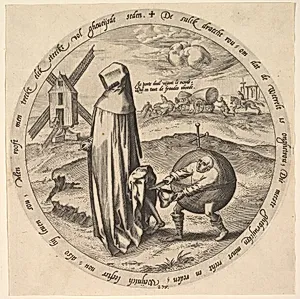
The Misanthrope Robbed by the World, from Twelve Flemish Proverbs
Medium
Engraving
Dimensions
Plate (diameter): 7 in. (17.8 cm) Sheet: 7 5/16 × 7 3/16 in. (18.5 × 18.2 cm)
Classification
Prints
Department
Drawings and Prints
Museum
Metropolitan Museum of Art, New York, NY
Credit
Harris Brisbane Dick Fund, 1946
Accession Number
46.21(21)
Rights
Public Domain
Tags
About this artwork
This engraving work by Pieter Bruegel the Elder|Jan (Johannes) Wierix, titled 'The Misanthrope Robbed by the World, from Twelve Flemish Proverbs' and created ca. 1568, represents an important example of artistic production from this period. Pieter Bruegel the Elder|Jan (Johannes) Wierix's practice contributed to the broader artistic traditions of the time, demonstrating the technical skills and aesthetic sensibilities characteristic of Drawings and Prints artworks in museum collections. The piec...
Art Historical Context
**The Misanthrope Robbed by the World**, from Pieter Bruegel the Elder's *Twelve Flemish Proverbs* series, is a captivating engraving created around 1568 and executed by the skilled printmaker Jan (Johannes) Wierix. Bruegel, a leading figure of the Northern Renaissance, was renowned for his intricate, satirical depictions of everyday life infused with Flemish proverbs—humorous moral lessons drawn from popular wisdom. This circular plate, measuring about 7 inches in diameter, exemplifies the collaborative genius of the era, where Bruegel's inventive designs were translated into fine engravings for wider dissemination. The composition buzzes with activity, featuring men, horses, carriages, and iconic windmills against a Flemish landscape, visually unpacking the proverb's theme of a disillusioned misanthrope outwitted by society's follies. Engraving's precise intaglio technique allowed Wierix to capture Bruegel's teeming details—tiny figures and symbolic vignettes—in a compact, jewel-like format, making complex narratives accessible to 16th-century viewers. Housed in the Metropolitan Museum of Art's Drawings and Prints department since 1946, this print highlights the cultural vibrancy of Renaissance Flanders, blending social commentary with masterful printmaking. It invites us to ponder timeless human quirks amid a whirlwind of proverbial chaos.
About the Artist
Pieter Bruegel the Elder|Jan (Johannes) Wierix · 1525–1569
Pieter Bruegel the Elder, a pioneering Netherlandish painter of the Renaissance, was born around 1525–1530, likely in Breda in the Duchy of Brabant (present-day Netherlands). Little is known of his early family background, but he apprenticed under the Antwerp painter and designer Pieter Coecke van Aelst between approximately 1545 and 1550, mastering tapestry design, architecture, and painting tech...