
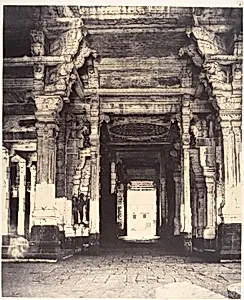
The Muduramiar Mundapam
January–March 1858
Medium
Albumen silver print from waxed paper negative
Dimensions
Image: 34.7 x 28.3 cm (13 11/16 x 11 1/8 in.) Mount: 57 x 45.2 cm (22 7/16 x 17 13/16 in.)
Classification
Photographs
Department
Photographs
Museum
Metropolitan Museum of Art, New York, NY
Credit
Gilman Collection, Purchase, Cynthia Hazen Polsky Gift, 2005
Accession Number
2005.100.381.2.4
Rights
Public Domain
Tags
Art Historical Context
Linnaeus Tripe, a British army officer and early photographer, created this striking image of The Muduramiar Mundapam while documenting South Indian architecture in early 1858. The photograph highlights the elegant stone columns and carved details of a traditional mandapam, or open pavilion, a common feature in temple complexes that served as gathering spaces for worship and ceremony. Tripe employed the albumen silver print technique from a waxed paper negative, a process that yielded rich tonal depth and fine architectural textures suited to the tropical light of India. His work formed part of a systematic survey commissioned by the British East India Company, preserving visual records of monuments at a time when photography was still a novel artistic and scientific tool. Today the print offers viewers a window into both the enduring craftsmanship of Indian builders and the beginnings of photographic exploration in Asia. Its careful framing of columns and space reveals Tripe’s eye for composition, transforming a documentary record into an aesthetically compelling study of form and light.
About the Artist
Linnaeus Tripe · 1822–1902
Linnaeus Tripe (1822–1902), born in Devonport, England, as the ninth of twelve children to Mary and Cornelius Tripe, pursued a military career influenced by his sister Emily's marriage to an army colonel. Joining the East India Company's Madras Infantry as a cadet in 1838, he rose to lieutenant in southern India by 1840 and captain in Bangalore by 1854. Extended leave in England from 1850 due to i...