
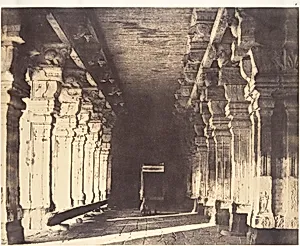
The Viravasuntarayan Munapam
January–March 1858
Medium
Albumen silver print from waxed paper negative
Dimensions
Image: 29.5 x 37 cm (11 5/8 x 14 9/16 in.) Mount: 46 x 57.1 cm (18 1/8 x 22 1/2 in.)
Classification
Photographs
Department
Photographs
Museum
Metropolitan Museum of Art, New York, NY
Credit
Gilman Collection, Purchase, Cynthia Hazen Polsky Gift, 2005
Accession Number
2005.100.381.2.2
Rights
Public Domain
Tags
Art Historical Context
Step into the shadowed grandeur of South Indian temple architecture with Lin Tripe's *The Viravasuntarayan Munam* (January–March 185). This albumen silver print from a waxed paper negative captures the ornate columns and pillared hall (munapam) of a Dravidian-style Hindu temple, likely in Tamil Nadu, the region's masterful stone carving traditions from centuries past. Tripe, a British Army officer turned photographer, documented India's ancient monuments during the colonial era as Photographer to the Madras Presidency. Working in the calotype process—using waxed paper negatives for detailed, large-format images—he produced some of the earliest systematic photographic surveys of South Asian architecture. This 29.5 x 37 cm print exemplifies the technical innovation of albumen prints, which offered sharp clarity and rich tones on paper coated with egg whites and silver salts. Held in The Metropolitan Museum of Art's Gilman Collection, the photograph preserves a vanishing cultural heritage, bridging Victorian-era documentation with timeless Indian artistry. Notice the rhythmic play of columns, evoking the temple's role in rituals and community life— a testament to photography's power to freeze history in light.
About the Artist
Linnaeus Tripe · 1822–1902
Linnaeus Tripe (1822–1902), born in Devonport, England, as the ninth of twelve children to Mary and Cornelius Tripe, pursued a military career influenced by his sister Emily's marriage to an army colonel. Joining the East India Company's Madras Infantry as a cadet in 1838, he rose to lieutenant in southern India by 1840 and captain in Bangalore by 1854. Extended leave in England from 1850 due to i...